Showing posts with label J. R. R. Tolkien. Show all posts

Friday, 16 August 2013

The Allure of Fantasy - Jareth and Crystal of Dreams


Down in the underground
You'll find someone true
Down in the underground
A land serene
A crystal moon
It's only forever
It's not long at all
- Underground, David Bowie


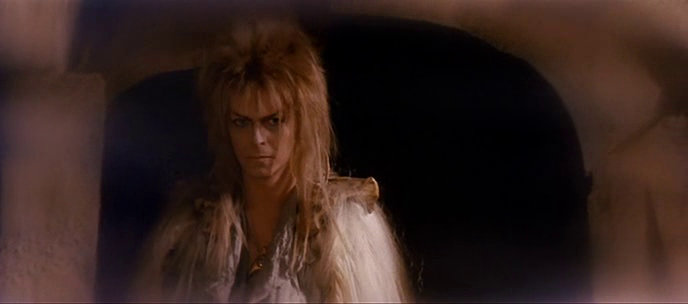
I watched Labyrinth for the first time last week, and it strongly affected me. Since then I have watched the whole movie twice more, certain scenes many more times, danced alone in my room to the soundtrack, and raged at the "unfairness" of the mundane world. Normally I am very attune to the magic and mystery inherent in all aspects of the world. But after Labyrinth my desire for fantasy increased to bittersweet intensity, and for a while my "real"  life seemed unsatisfactory in comparison with imagination. I was intrigued by the strength of my emotions - the co-mingled joy and sorrow - the unrequited longing after the fantasy world and the goblin king.


Look at what I'm offering you. Your dreams...

I sought words to describe my state - and Tolkien's words from On Fairy Stories resonated within my mind:
The realm of fairy-story is wide and deep and high and filled with many things: all manner of beasts and birds are found there; shoreless seas and stars uncounted; beauty that is an enchantment, and an ever-present peril; both joy and sorrow as sharp as swords.

Yes, I thought. This is the feeling that burns within me - which I have felt before. It is the mark of Faerie - the longing felt by those who have once crossed into that Other World, and who pine for it on their return to mundane life. Cecilia Dart-Thornton named it Langothe - and anyone who has even briefly entered fantasy, and afterwards felt the "real" world to be unsatisfactory and diminished, will know how it feels - a poignancy of spirit, in which beauty and despair are inseparable.

This feeling may be sparked by different things - a piece of music; a painting; a reflection upon water. I have felt it come upon me when I was looking at The Beguiling of Merlin; reading Ode to a Nightingale; watching the elves in The Lord of the Rings; and at the end of Prince Caspian. All of these things have in common a "light better than any light that ever shone, in a land no one can define or remember, only desire".

Something about Labyrinth made me react the same way. But it was not the labyrinth itself that I desired - nor the company of the grotesque creatures that Sarah meets along the way. My feelings coalesce around Jareth the Goblin King. But why?

Need you ask?

Looking past the obvious - David Bowie's magnetic and mesmerising performance, and Jareth's spectacular appearance (which is undeniably attractive) - the character of the Goblin King seems to personify fantasy, with its capacity for both beauty and darkness. 

He is by times exuberant and dazzling; cruel and tender; careless, entreating and sorrowful. Mercurial and fey, he is archetypal - the trickster, the animus - at once the shadow and the hero.


How are you liking my labyrinth?

I'll leave my love between the stars.

I'll make you a prince. Prince of the land of stench!

The power of voodoo!

He shapes the world of Faerie and creates the story - the labyrinth - through which Sarah can express her heroic journey. He creates "dangers untold and hardships unnumbered", so that Sarah can overcome them. 

She'll never give up!
Won't she?

Within the labyrinth, Sarah undergoes a mythic quest - and on the way learns to find her innate courage, to look beyond appearances, to stop taking things for granted, to resist temptation, to show compassion, to realise her love for her little brother - and to exercise her fantasies. The journey is a universal one of maturation and development. But essentially - Jareth is the storyteller.

Jareth's fascination therefore, is his ability to craft living stories - a fully-realised fantasy world (the ultimate in subcreation, put in Tolkien's terms). Who can help loving a character who bestows gifts of beautiful dreams? In Labyrinth, the fairies do not grant wishes, but the Goblin King is master of wish-fulfillment.

There's such a fooled heart -

- beating so fast 
- in search of new dreams...
A love that will last within your heart.

I'll place the moon within your heart...

Part of the sorrow of Labyrinth has to do with the tragic bind in which Jareth finds himself. The storyteller becomes confined by the story - by "the way it has to be". Despite his capacity and desire to transcend the "villain" role - expressed in the masquerade-dream he crafts for Sarah - despite his dissatisfaction with his goblin subjects, his affection for Toby and his loneliness - his "generosity" drives his inevitable defeat. 

What have you done that's generous?
Everything.
You asked that the child be taken -

- and I took him.
You cowered before me - I was terrifying.

I have re-altered time.
 I have turned the world upside down -
- and I have done it all for you.
I am exhausted - 
- from living up to your expectations.
Isn't that generous?

This explains the pain in his last song, when Sarah seeks Toby in the "Escher" room. Jareth loves her - believes in her ability to rescue her brother. But he knows that when she succeeds, she will leave the labyrinth. Jareth's grief is his knowledge of the inevitability of Sarah's departure - the finite time she has left in the fantasy world he created for her. 

Your eyes can be so cruel. Just as I can be so cruel.
Though I do believe in you.
Live without your sunlight. Love without your heartbeat.
I - I can't live within you.

Watching the movie, the mingled love and pain that Jareth feels echoes in my own heart. But the archetypal, fairy-tale nature of the story extends and amplifies these feelings. As Jareth sings his desolate song - I burn with unrequited love for the heart of Faerie. Just as Sarah cannot stay in the labyrinth, neither can I stay in the fantasy. The sorrow is the unrequited longing for permanence in something that is by nature fleeting. But a mere glimpse of this beautiful world makes me realise the truth of Yeats' "dull world" of the mundane. And so I long for the fantasy even more desperately. In vain. As Jareth knows to his sorrow, no matter how much we wish to live in it, a fantasy is ephemeral as a bubble. 

Before the story began, Jareth knew how it would have to end.
"Give me the child!"
"You have no power over me..."

But there is one thing that one must always remember about the fae-folk. They cannot die. Jareth is defeated, but he changes into an owl. He was only required to be the villain up until Sarah reached the words "you have no power over me". But that was the middle of Labyrinth book. A fairytale does not ever end. Fantasies are blown and burst like bubbles, but Jareth has an inexhaustible store - as numerous as the dreams of a fertile mind. The labyrinth is only part of the infinite world of Faerie - the limitlessness and eternally changing nature is unconstrained. 

Stories continue and are retold and shaped again and again. 

I am fortunate. I am one of those who have access to Faerie - to its glimpses of mystery, heroism, grandeur, beauty and terror. Unrequited desire is the price that I must pay for entering. But I would rather burn forever with the Langothe than live without the glorious, strange and enchanting world.

After watching Labyrinth, let me modify Tolkien's famous words:

"I desired Faerie with a profound desire… the world that contained even the imagination of Jareth was richer and more beautiful, at whatever cost of peril."

This is no ordinary gift...
I'll be there for you
As the world falls down
Falling
Falling
As the world falls down
Falling in love

Thursday, 14 February 2013

Why Do We Desire Dragons? A Dragon-Seeker's Quest


The dragon is the patron saint of all storytellers and artists” – Guillermo del Toro
"I choose to believe in dragons." - Robin Hobb 

Tintaglia by John Howe, for Robin Hobb's "Ship of Destiny" 

 This blog post was inspired by Terry Windling's "Moveable Feast" on the topic of The Desire for Dragons: What Brings Us to Myth and Fantasy?.

I think it is a question that every person who has ever felt the "desire for dragons" should ask themselves, not in an attempt to "explain the magic away" but in a quest to discover these elusive beasts and on the way, perhaps to ourselves... It is a question that leads into a hundred other questions, for example:

Why is it that we out of everyone in the world feel most strongly a desire for Faerie - for myth and story - for transcendence and legend and perilous beauty? Is it innate - like a magic of old - or is it something that is taught? Why do only some people feel it, and why do others become accountants?  What is the "real" basis of our desire and belief? How much should we care about "reality" anyway? Is story more important than reality? Does story create reality? What is lacking in modern life, that we turn with wistful eyes to a mystical past that never existed save in story? How can we live according to such precepts? How can we use story to make the world we live a better place? Why dragons?

Dragon and Warrior Princess by John Howe

Well, I think the answers to all these questions can only fully be discovered, and crafted, over a lifetime. So as Woolf would say, if you are looking for a "nugget of truth" I'm afraid you won't be getting one (sorry dragons - but gold is shinier than truth anyway). 

Smaug the Golden by John Howe
He seems to agree...
Instead I invite you on my dragon-seeking quest. With staff in hand and dusty sandals, armed with nothing more than a pencil and a roll of parchment (or pad of paper, take your pick) we shall follow the road that leads away across the hills, into the mountains and beyond. And perhaps on the way we will find some glimmerings of the elusive answers to our questions, on the sun-caught wings of a dragon high above, or the dully metallic scales of a Worm wrapped around a hill; or between the serpents coiling at the edges of an old map...

Earthsea by John Howe

Where shall we seek? It does not matter. Dragons are not difficult to find. As anyone with a rudimentary knowledge of world mythology would know, dragons have colonised all the earth and sea and sky. From China to Australia; from South America to Africa to Britain - in all places where humans have settled, it would seem that dragons have preceded them. Sailors feared the deeps for the serpents that lurked below the surface, beyond sight but not beyond knowledge. When the first maps were created the edges of the "known" were marked and everyone knew that dragons were beyond. After rain, we glimpse the tail of the Rainbow Serpent. Look up into the sky at night, and the shining length of "Draco" can be seen. Dragons can be sought - and found - everywhere. It all depends on how you look.

Sea Dragon by John Howe
You would be wise to fear the deeps...

I seem to be blessed with the ability to see dragons. Almost everything I see can be evidence of a dragon - the jagged, granite peaks of a mountain so easily becomes the spine of a sleeping, half-buried dragon, and a massing bank of clouds becomes, with little effort, dragon's breath. Of course, at the same time I "know" that the granite spine was formed by erosion and geological forces of the earth, and the clouds are shaped by air pressure and evaporation. But somehow, strangely, all my scientific knowledge does not diminish my wonder. 

Dragon Isle by John Howe 
I see dragons everywhere... and clearly so does John Howe. 

The dragons and the "magic" of the world I sense every day have the same solidity in my mind as the scientific phenomena. They exist, in my mind, on parallel planes. I do not deny scientific "reality", nor do I believe that the "real-ness" of magic and dragons is the same kind as this more mundane knowledge (though it is as important to me). 

The Stone Dragon by John Howe for Robin Hobb's "Assassin's Quest" 

Tolkien wrote in his essay On Fairy Stories:

“Fairy-stories were plainly not primarily concerned with possibility, but with desirability. If they awakened desire, satisfying it while often whetting it unbearably, they succeeded… The dragon had the trade-mark Of Faerie written plain upon him. In whatever world he had his being it was an Other-world. Fantasy, the making or glimpsing of Other-worlds, was the heart of the desire of FaĆ«rie. I desired dragons with a profound desire... the world that contained even the imagination of Fafnir was richer and more beautiful, at whatever cost of peril.”
That is the gift of dragon-sight; the purpose of the dragon quest. Dragons embody the beauty and the peril of an "other world" that is "richer and more beautiful" and full of strange and marvellous things. Ah - I see a glimmer of an answer - a flash of desire on the wing of a dragon! I understand a part of why I desire Faerie - and dragons - with such aching passion. When life can contain "even the imagination" of such eldritch possibility - when a world of unplumbed depths of mystery exists alongside our own - then what a glory is opened to the soul! What visions of wonder, far beyond the ken of mortal sight, unfold before the inner eye, lit by a "light better than any light that ever shone; a land no one can define or remember, only desire"... 

 "In this unfolding, ever-changing but constant drama, dragons have always played a role. They are among the First...They embody concepts of considerable importance and they are clothed in scales. Their origins are inextricably interwoven with our psyche, and they breathe fire. They are Freudian and, better still, eminently Jungian, and they spread vast wings over the sky.”  - John Howe, Forging Dragons

Dragon of Chaos by John Howe
The dragon that created the cosmos...
Volcanic Dragons by John Howe

I have heard people say that science killed magic. I disagree. Science is an exploration - an attempt to penetrate mystery. Artists and writers; scientists and mathematicians - all share a desire to explore and to discover. I do not think that science explains everything - Mystery abounds yet, and dragons were ever the gate-keepers of mystery.

The Gates of Night by John Howe

This is why, I believe, dragons are such potent and universal figures; so beloved by storytellers and artists from the beginning of human thought. That is why they are so tenacious, and will not let themselves be rooted from our stories, from the land or from our consciousness. That is why I follow their fiery trails, ever seeking Faerie. And that is why I think dragons are eternal. No matter how "advanced" humanity becomes in scientific pursuits, the dragon will be there.

"The skies of this world were always meant to have dragons. When they are not here, humans miss them. Some never think of them, of course. But some children, from the time they are small, they look up at the blue summer sky and watch for something that never comes. Because they know." - Robin Hobb, Golden Fool

Dragon Moons by John Howe
Fool's Fate by John Howe, for Robin Hobb's book of the same name 


Friday, 11 January 2013

"I'm Going on an Adventure!"


The world is not in your maps and books - it is out there... Gandalf, The Hobbit: An Unexpected Journey


I met Gandalf the other day, and he asked me to go on an adventure. And I said yes. Here’s how it came about.

I watched The Hobbit movie recently. Actually I saw it twice. It’s a beautiful movie, full of the magic and depth, great acting and integrity we’ve come to expect and love from Peter Jackson. As expected, it took me on an immersive journey through Tolkien’s marvellous world and filled me with many conflicting emotions. I felt joy, and a great wonder at the beautiful places I saw, and I was moved both to laughter and tears; heroic admiration and absolute loathing; pity and envy. But it was the envy that inspired a chain of thought that led to Gandalf knocking at my door.


It began with “Good morning!” As soon as Bilbo set his eyes on the wandering wizard I felt instant envy and exasperation. How on Middle Earth did Bilbo fail to recognise Gandalf as being somehow special? I think – my feelings not entirely rational, and surely clouded by my being privy, as someone familiar with the lore of Middle Earth, to the innumerable instances of Gandalf’s extraordinary nature… But anyway – such was my instinctive thought that it led to a fellow thought, as surely as Balin follows Dwalin. As soon as Gandalf spoke the words “I’m looking for someone to share in an adventure,” this thought makes its presence known. Pick me! Pick me! I want an adventure! Why does Bilbo hesitate? Wait -what is he saying? “Nasty unpleasant things”? What a fool! Gandalf – leave that idiot and pick me! I would jump at the chance! And this feeling persists all through the Unexpected Party. I thrill at the unfurling of the map of Erebor, and share the dwarves’ enthusiasm for the quest. Although my rational mind understands Bilbo’s demurral, I can’t help but feel that were I given the same opportunity, Gandalf would not have to ask twice.

"...laceration, evisceration - incineration?!" 
Surely the longing for adventure is an integral part of humanity? Do we not all have a part of us that longs to escape the ordinary? In history I can find many examples – too many to list – of humanity’s audacity and the glorious results of their adventures. It was in the spirit of adventure that, thousands of years ago, people paddled in tiny coracles across vast and unmapped oceans to settle in the islands of Polynesia. It was in the spirit of adventure and discovery that the wonders of the natural world and science were revealed, that we discovered how to harness electricity – that we set foot on the Moon and plumbed the crushing depths of the sea. And in story, song and legend – the inspirational tales are always of adventures… of people who go beyond the average and who dare greatly and win glory.

I have grown up on tales of adventure. I hunger for it. I dream of heroism and of discovery. Surely therefore I would not hesitate, like Bilbo, to take the opportunity – I would never be left alone in a spotless house wondering what would have happened if I had gone with the Company to the Lonely Mountain! Or would I?
The Map of the Lonely Mountain

Suddenly I considered my life and reviewed it – were there any times that I could have gone on an adventure and chose the safe option? Were there opportunities that I let slip away because of laziness… or fear? In that moment I realised – that Gandalf appears in many guises and adventures take many forms. And he comes to all of us, and many times. And I realised that all the greatest experiences and achievements in my life so far have come when I have said “yes” to the offer of an adventure. The adventure could be starting a new creative project, learning a language, travelling, starting a new job, developing a personal relationship – anything that has the potential to lift life out of the ordinary. Each adventure comes with dangers and hardships to face – risks of failure and no promise of return.


Gandalf: You'll have a tale or two to tell when you come back.
Bilbo Baggins: Can you promise that I will come back?
Gandalf: No. And if you do, you will not be the same. 

What then is the reward of adventure? I think it is a new horizon, the satisfaction of striving and of testing yourself, of discovery and – perhaps – glory and renown. At the end. If you are lucky there might also be treasure. But most important is the moving and the personal growth. Bilbo discovers bravery and cleverness, resourcefulness and hardiness within himself, and a wanderlust – qualities that he would never have known if he had not stirred from his comfortable armchair. Adventures teach us to ignore and defeat doubt, and to step outside the comfort of our hobbit-hole and to move beyond the expectations of our peers - to discover the forests and mountains, the beauty of Rivendell and the splendour of the Eyrie; to face that which we fear and face ourselves.


This was the wisdom I learned from The Hobbit, and straightaway began an adventure – starting my own creative business. Who knows what I will discover, and how it will change me, and what new horizons I will see... 

I'm going on an adventure!