Showing posts with label mythic. Show all posts

Friday, 16 August 2013

The Allure of Fantasy - Jareth and Crystal of Dreams


Down in the underground
You'll find someone true
Down in the underground
A land serene
A crystal moon
It's only forever
It's not long at all
- Underground, David Bowie


I watched Labyrinth for the first time last week, and it strongly affected me. Since then I have watched the whole movie twice more, certain scenes many more times, danced alone in my room to the soundtrack, and raged at the "unfairness" of the mundane world. Normally I am very attune to the magic and mystery inherent in all aspects of the world. But after Labyrinth my desire for fantasy increased to bittersweet intensity, and for a while my "real"  life seemed unsatisfactory in comparison with imagination. I was intrigued by the strength of my emotions - the co-mingled joy and sorrow - the unrequited longing after the fantasy world and the goblin king.


Look at what I'm offering you. Your dreams...

I sought words to describe my state - and Tolkien's words from On Fairy Stories resonated within my mind:
The realm of fairy-story is wide and deep and high and filled with many things: all manner of beasts and birds are found there; shoreless seas and stars uncounted; beauty that is an enchantment, and an ever-present peril; both joy and sorrow as sharp as swords.

Yes, I thought. This is the feeling that burns within me - which I have felt before. It is the mark of Faerie - the longing felt by those who have once crossed into that Other World, and who pine for it on their return to mundane life. Cecilia Dart-Thornton named it Langothe - and anyone who has even briefly entered fantasy, and afterwards felt the "real" world to be unsatisfactory and diminished, will know how it feels - a poignancy of spirit, in which beauty and despair are inseparable.

This feeling may be sparked by different things - a piece of music; a painting; a reflection upon water. I have felt it come upon me when I was looking at The Beguiling of Merlin; reading Ode to a Nightingale; watching the elves in The Lord of the Rings; and at the end of Prince Caspian. All of these things have in common a "light better than any light that ever shone, in a land no one can define or remember, only desire".

Something about Labyrinth made me react the same way. But it was not the labyrinth itself that I desired - nor the company of the grotesque creatures that Sarah meets along the way. My feelings coalesce around Jareth the Goblin King. But why?

Need you ask?

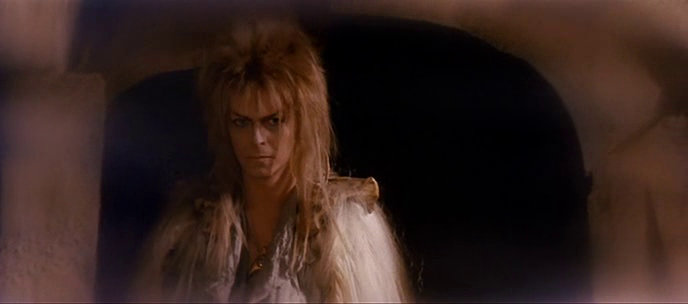
Looking past the obvious - David Bowie's magnetic and mesmerising performance, and Jareth's spectacular appearance (which is undeniably attractive) - the character of the Goblin King seems to personify fantasy, with its capacity for both beauty and darkness. 

He is by times exuberant and dazzling; cruel and tender; careless, entreating and sorrowful. Mercurial and fey, he is archetypal - the trickster, the animus - at once the shadow and the hero.


How are you liking my labyrinth?

I'll leave my love between the stars.

I'll make you a prince. Prince of the land of stench!

The power of voodoo!

He shapes the world of Faerie and creates the story - the labyrinth - through which Sarah can express her heroic journey. He creates "dangers untold and hardships unnumbered", so that Sarah can overcome them. 

She'll never give up!
Won't she?

Within the labyrinth, Sarah undergoes a mythic quest - and on the way learns to find her innate courage, to look beyond appearances, to stop taking things for granted, to resist temptation, to show compassion, to realise her love for her little brother - and to exercise her fantasies. The journey is a universal one of maturation and development. But essentially - Jareth is the storyteller.

Jareth's fascination therefore, is his ability to craft living stories - a fully-realised fantasy world (the ultimate in subcreation, put in Tolkien's terms). Who can help loving a character who bestows gifts of beautiful dreams? In Labyrinth, the fairies do not grant wishes, but the Goblin King is master of wish-fulfillment.

There's such a fooled heart -

- beating so fast 
- in search of new dreams...
A love that will last within your heart.

I'll place the moon within your heart...

Part of the sorrow of Labyrinth has to do with the tragic bind in which Jareth finds himself. The storyteller becomes confined by the story - by "the way it has to be". Despite his capacity and desire to transcend the "villain" role - expressed in the masquerade-dream he crafts for Sarah - despite his dissatisfaction with his goblin subjects, his affection for Toby and his loneliness - his "generosity" drives his inevitable defeat. 

What have you done that's generous?
Everything.
You asked that the child be taken -

- and I took him.
You cowered before me - I was terrifying.

I have re-altered time.
 I have turned the world upside down -
- and I have done it all for you.
I am exhausted - 
- from living up to your expectations.
Isn't that generous?

This explains the pain in his last song, when Sarah seeks Toby in the "Escher" room. Jareth loves her - believes in her ability to rescue her brother. But he knows that when she succeeds, she will leave the labyrinth. Jareth's grief is his knowledge of the inevitability of Sarah's departure - the finite time she has left in the fantasy world he created for her. 

Your eyes can be so cruel. Just as I can be so cruel.
Though I do believe in you.
Live without your sunlight. Love without your heartbeat.
I - I can't live within you.

Watching the movie, the mingled love and pain that Jareth feels echoes in my own heart. But the archetypal, fairy-tale nature of the story extends and amplifies these feelings. As Jareth sings his desolate song - I burn with unrequited love for the heart of Faerie. Just as Sarah cannot stay in the labyrinth, neither can I stay in the fantasy. The sorrow is the unrequited longing for permanence in something that is by nature fleeting. But a mere glimpse of this beautiful world makes me realise the truth of Yeats' "dull world" of the mundane. And so I long for the fantasy even more desperately. In vain. As Jareth knows to his sorrow, no matter how much we wish to live in it, a fantasy is ephemeral as a bubble. 

Before the story began, Jareth knew how it would have to end.
"Give me the child!"
"You have no power over me..."

But there is one thing that one must always remember about the fae-folk. They cannot die. Jareth is defeated, but he changes into an owl. He was only required to be the villain up until Sarah reached the words "you have no power over me". But that was the middle of Labyrinth book. A fairytale does not ever end. Fantasies are blown and burst like bubbles, but Jareth has an inexhaustible store - as numerous as the dreams of a fertile mind. The labyrinth is only part of the infinite world of Faerie - the limitlessness and eternally changing nature is unconstrained. 

Stories continue and are retold and shaped again and again. 

I am fortunate. I am one of those who have access to Faerie - to its glimpses of mystery, heroism, grandeur, beauty and terror. Unrequited desire is the price that I must pay for entering. But I would rather burn forever with the Langothe than live without the glorious, strange and enchanting world.

After watching Labyrinth, let me modify Tolkien's famous words:

"I desired Faerie with a profound desire… the world that contained even the imagination of Jareth was richer and more beautiful, at whatever cost of peril."

This is no ordinary gift...
I'll be there for you
As the world falls down
Falling
Falling
As the world falls down
Falling in love

Sunday, 3 March 2013

The Elusive Quality of Autumn

Autumn leaves in a forest pool...
I am enamoured of Autumn.

It is such an exciting time of year - a season of colour and contradictions; harshness and sensuality, sorrow and celebration. It is a time of fruiting and of dying - a season both "mellow" and tempestuous. It is a time of mystery - a transitioning time from the light and life of summer to the dark, bleak time of winter. As with all "between" times, it eludes definition, save through a poet's metaphors and an artist's brush. 

Mist blurs the boundaries of perception - autumn is a season of mystery...
When we think of autumn we tend to think in terms of images, sensations, emotional stirrings and stories. So I have found it, at least. In writing this blogpost I found my first attempts to describe and define my love for this strange and changeful time of year to be pitifully inadequate in their colourless generalisation;, and found myself recounting instead my vivid memories and perceptions of the season.

Autumn at Ashley's Cottage by Thomas Kinkade


Autumn can be beguiling and sensuous. It is  time when one has a pleasant excuse to stay indoors, wrapped in soft wools while it rains or mist envelopes the house. At this time of year we revel in the crackle, the light and the sharp, exciting smell of an open fire; and we taste the sweetness of stored summer sunlight in the taste of a ripe plum or bulbous, juicy berry and rejoice... Hot, filling, homecooked meals fill us with a contentment and comfort provided by a bounteous harvest.


The traditional harvest feast of Mabon
"Who hath not seen thee oft amid thy store?Sometimes whoever seeks abroad may findThee sitting careless on a granary floor..." - Ode to Autumn, John Keats


Autumn's harvests have traditionally been celebrated with festivals of mythic, religious and communal significance. Though harvest festivals have been of recent years too often commercialised and trivialised in the Western World, I was fortunate enough to experience some of their traditional, mythic flavour when I was in primary school. I attended a Rudolph Steiner school, and in April we celebrated with a communal feast of light and song and story. Each family contributed homebaked food and fresh harvest fruits. The mudbricked ovens (built by children's hands) glowed from within, as hippie parents with long hair and colourful clothes baked pizza on handcarved paddles. In the amphitheatre, surrounded by bushland and decorated with paper lanterns painted with watercolour, the children acted out the mythic archetypes of hero, saint, princess and king. Music was provided by a group of children playing wooden recorders, while others chanted the narration. A drumbeat was heard. From the shadows of the trees came a horned and snakelike figure - a dragon with a dozen little bare feet, pounding joyfully on the dirt. 


Samhain

Dark tales are associated with autumn; a season that is not merely about fruitfulness, but also dying...
Of course, there are darker rituals associated with autumn than the one in which I participated. Darker stories that, however legendary, hold a "truth" in the mind and shape my perception of the season. Autumn evokes for me stories of Samhain - images faces half-bestial and eldritch flickering in and out of shadows at the edge of firelight. The pages of an old book of tales evokes Old British spirits and superstitions, and eerie tales of witches and "ghosties and ghoulies and lang-legged beasties" told around the hearth. There are tales of blood and death and the things beyond the grave that prick the skin on the back of the neck, while outside the wracked trees claw at the stormy sky.

Mist is incredibly evocative...

Keats was right when he said autumn was a "season of mists and mellow fruitfulness", though that description of course does not encompass the whole. Many of my most abiding memories of autumn are of mist rolling into my garden, obscuring the valley and the mountains, beading crystal droplets on the leaves of trees and grass and clover. Some drops roll into the centres of nasturtium leaves, making me think of the pearly dew in the story of Jorinda and Jorindel. Mist also bedews the needle-like leaves of the juniper (blue-green, now taking on a reddish tint) and the golden fringes of the cypress tree. Mist encrusts the wool of my jumper, and my eyelashes and hair. It creates mystery, but gently. It beautifies, even as it conceals. 

Autumn rain
Autumn is also a time of rains - fierce, driven and torrential. Yesterday I looked out of my window at the harbour and marveled at the glory of a rainbow across the water. Five minutes later the entire harbour was blotted from my sight in a sudden flash-downpour that was so forceful, the roofs of the houses below me seemed to "smoke" from the spray sent-up with each droplet. After a minute of white near-blindness, I saw blue sky through the pouring rain. In another two minutes, the rain had completely stopped and the sky was clear again. 

But as well as being a season of darkness and diffuse dimness, Autumn is a season of colour and splendour. The very light is more golden; all colours are more saturated and the sky deepens to a rich sapphire. Most spectacularly the leaves of deciduous trees blaze forth in innumerable shades and hues.

The myriad colours of autumn
How many shades are there of red? Our language can describe crimson, scarlet, vermillion, carmine, blood-red, cerise, claret, puce, roseate, garnet, geranium, russet, rust and titian... And of the other flame hues: yellow and orange, the thesaurus provides us with: champagne, xanthic, creosote, aureate, aurulent, citrine, canary, fallow, flavescent, flavicomous, fulvid, lutescent, primrose, sallow, sulphur, xanthous, tawny, sunshine, ochrous, saffron, cadmium, apricot, bittersweet, carrot, coral, salmon, tangerine, titian and auburn. For  brown we have amber, auburn, bay, beige, bister, brick, bronze, buff, burnt sienna, chestnut, chocolate, cinnamon, cocoa, coffee, copper, drab, dust, ecru, fawn, ginger, hazel, henna, khaki, mahogany, nut, ochre, puce, russet, rust, sepia, sorrel, tan, tawny, terra-cotta, and umber. For green (and there is green in autumn) we have: apple, beryl, bice, chartreuse, fir, forest, malachite, jade, peacock, moss, olive, verdigris, viridian, pine, sage and sap.

Fallen leaves on wet stone - what image can do justice to the indescribable scent and colour of reality?
This is a mighty, and one might say, comprehensive list. But how many of these words are but the names of trees and plants and pigments, found in nature? And what of the myriad tints and gradations that cannot be written? A painter could better capture this iridescence with a brush, but the breadth and vibrancy of Nature's palette in Autumn is unrivaled by any mortal artistry. 

Autumn Leaves, by John Everett Millais
And oh - what are the words for the scents of Autumn? How can one do justice to the smell of wet leaves underfoot; the smell of sunwarmed blackberries or the smell of wood-smoke? And what about the emotions evoked in the soul by the sight of departing birds, flying in wavering arrows towards a warmer land; or the wildness stirred in the soul by the rising winds, until the feet and blood pull you pelting down the road to dance with the blowing leaves; or the state of peaceful melancholy evoked by the contemplation of yellow willows trailing in a slow-moving stream?

The wild winds of autumn stir the soul...

... and set one dancing with the leaves
Autumn seems to me sometimes like a beautiful, emotionally-volatile lover, who dazzles the eye differently in every changing hour; a lover who can be fierce and gentle and cold; generous and destructive; golden and pale and lowering storm all in one day... Infinitely fascinating; infinitely complex; infinitely beautiful. One who never lets you see their whole self - yet in the facets revealed to you is such a beauty that you spend the rest of the year musing on the mystery of their being. One who mocks you for your pitiful attempts at definition.


The Spirit of Autumn
Perhaps the wisest words belong to Robin Hobb, who wrote in her beautiful novel Golden Fool:

"Words do not contain or define any person. A heart can, if it is willing."

I think the same could be said of a season. 

Close bosom-friend of the maturing sun...

Thursday, 24 January 2013

The Snow Queen: Visions of Female Strength

The imperiously beautiful Snow Queen covers the town with a carpet of white 

Hans Christian Anderson's fairy stories have a peculiar, thought-provoking quality - a certain kind of magic that the better-known tales of the Brothers Grimm do not possess. Perhaps it is that his visions do not conform to the archetypes that pervade other fairy stories, or that they cannot be easily categorised. Some are more akin to myth; others are allegorical. Some are darkly funny, and yet others are pretty fancies full of charm but not much substance. While several of his stories are well known and appreciated today (the Little Mermaid, Little Thumb (Thumbelina), and the Steadfast Tin Soldier among others) - some of his lesser known works are uniquely powerful, such as the evocative The Bell, the patriotic Holger Danske and the strangely humorous Galoshes of Fortune. 

His best stories are those which are both mythic and allegorical - yet suffused with emotion and undeniable loveliness. Of all his tales The Snow Queen is my very favourite, for many reasons. I love the sheer glory and vibrant colour of the vision and its epic scope - with the window boxes; the robber cave; the garden of flowers and each flower's vision; the hanging beds like lilies in the palace the shadowy, galloping dreams; the flickering aurora hanging like curtains of light - and of course the  Snow Queen with her pristine and terrible beauty. I love the humorous touches - like the Raven couple and the wise woman writing words on a piece of dried fish. I love how the story of Gerda's journey seems to intersect with other, equally epic stories - like that of the princess and the robber girl. Most of all, I love the strong female characters, out of whom each have different agendas and competing powers - yet none of whom end the tale defeated. Alone among all fairy stories - this tale is one in which the female occupies almost all the heroic parts.

Here follows a description of these awesome female characters.

Gerda

Gerda and little Kay
Art by Arthur Rackham 
Gerda is the main heroine of the tale, and she undergoes a remarkable development through the story - gaining strength and courage through her adventures, while retaining her essential core of love and honesty.

In the beginning of the story, Gerda is an innocent little girl, who feels glee and simple pleasure in play and stories. When Kay becomes nasty and reductionist due to the splinter of enchanted glass in his eye and in his heart, she remains loyal to their friendship - and when he is thought dead, having tied his sled to the Snow Queen's chariot and disappeared, she nevertheless goes to seek him. At the start of her quest, Gerda behaves like any child would be expected in these circumstances - easily frightened and confused; trusting and gullible. Thus she is delayed (possibly for many years) by a witch and her garden - but in being reminded of her quest by the reappearance of roses, she makes the difficult choice to leave the comfort of the witch's abode where she "slept and dreamed as delightfully as any queen".

The door was locked; but she pressed heavily against the rusty hinges, and it sprang open, when out she ran in her bare feet, into the wide world... When she could run no long she... saw that the summer was gone; it was late in the autumn... How grey and depressing it was in the wide world!

Soon after this interlude, Gerda is befriended by a Raven, having learned bitterly "how much there lay in that one word "alone"" and despite hearing that Kay has supposedly married a princess of surpassing cleverness and beauty, she feels neither crippled by jealousy nor inferiority but with the help of the Raven's sweetheart creeps into the palace to the royal chambers. Here she is disappointed - for the new prince is not little Kay, but she does not lose hope. Resisting for the second time the lure of a pleasant life, this time in the palace, Gerda begs instead for the means to "go out again into the wide world" on her quest. She is given a golden coach.

They drove through the dark forest, but the carriage gave light like a torch, which affected the robbers' eyes so that they could not bear it. "That is gold! That is gold!" they cried, and rushing forward seized the horses...
Artwork by Arthur Rackham
Captured by a band of violent robbers, Gerda narrowly escapes death through the whim of the robber-girl, yet still does not give up on her quest, enlisting the aid of the robber girl and her animals. She is finally given a reindeer and set free, to continue her journey into the forbidding winter wilderness.

And the Reindeer flew as fast as possible through the great forest, and over heaths and marshes... "There are my old friends the northern lights," the Reindeer said; "see how they shine!" It ran day and night.
Artwork by PJ Lynch
From the frozen home of the wise "Lapland woman"  Gerda and the Reindeer journey to the strange hot-house of the "Finland woman". Here the Reindeer asks for Gerda to be given "the strength of twelve men, so that she may vanquish the Snow Queen". But the Finland woman knows better - scoffing at the suggestion: "that would help her a great deal!" Instead she recognises Gerda's inner strength, derived from her good and loving heart, and from her childlike belief in universal goodness.

"I cannot give her greater power than she already possesses, and do you not see how great that is? Do you not see that men and beasts must serve her and how, barefooted as she is, she has got on so well in the world? She cannot receive her power from us, that is in her own heart..."
Unlike the majority of fairytale heroes, who are endowed with magical gifts or otherworldly assistance, Gerda is now left "without boots and without gloves, in the middle of that fearfully cold Finland".  Undaunted, she continues alone, only to be met by a horde of icy monsters - the guards of the Snow Queen. But the words of the Finland Woman hold true - for Gerda's very breath solidifies into a host of golden warriors who "thrust their spears into the frightful snowflakes, breaking them into hundreds of pieces", and removing the chill from Gerda's hands and feet.

Gerda's breath becomes an army of golden angel-warriors who utterly rout the snow-monsters.
Artwork by PJ Lynch
 Thus she is able to enter the palace of the Snow Queen, and through her love and "bitter, burning tears" she rescues Kay and redeems him, washing the splinter of glass from his heart and thawing the ice.

Kay and Gerda reunited.
Artwork by PJ Lynch

Together then, the quest achieved, they turn homewards through a "beautiful, warm summer". Gerda has grown in that she has endured hardship and terror, and realised her inner strength. Yet she has also retained her child-like simplicity and empathy. Thus she (and through her, Kay) are "grown up and yet children" at the conclusion of the tale.

It is interesting to compare Gerda's journey and development with that of male archetypal heroes in fairytales - those who begin their quest to gain some prize (a golden apple or a throne or a king's daughter) or to slay some enemy\; who overcome their opponents through force or cunning, and often with magical aid, and whose reward is inevitably personal power and a lovely maiden to wife. Gerda is full as heroic as these characters - yet in comparison her motivations are less selfish, her methods less confrontational and her triumph more personal. If only there were more fairytales with such strong and positive female protagonists!

Grown up and yet children...
Artwork by PJ Lynch

The Princess

The princess is a supplementary character who only appears in one of the chapters of the Snow Queen story - but she is nonetheless an admirable and inspirational female character, whose story hints at a much longer and grander untold narrative.

According to the Raven:

"In this kingdom in which we are now sitting, lives a Princess, who is so immoderately clever; but then she has read all the newspapers that are in the world, read and forgotten them again, so clever is she. Lately she was sitting on her throne, when she began to sing, and the theme of her song was "Why should I not marry?" "Well there is something in that, she said, and so she determined to get married; but she must have a husband who knew how to answer when spoken to, not one who could only stand there and look grand, for that is too stupid."

What a fantastic introduction to a character! And what a refreshing change from the fairytale standard of princesses being first and foremost beautiful! The Princess decides on her own that she wants to get married, and she then goes on to specify what kind of a husband she is looking for - one who is intelligent, unabashed by royalty, unafraid of her power and one who "feels at home' with her.

The Raven then goes on to describe the meeting of the princess and her husband-to-be:

"He was gay and well behaved, but had not come at all to pay court to the Princess, but only to hear how clever she was. He had every reason to be satisfied with her, and she no less so with him."

Again, what a refreshing subversion of the princess trope! The princess' chosen husband is bright-eyed and merry; a poorly dressed "little person" - a wanderer with creaking boots and a knapsack on his back. No dragonslayer he - but one who can match the princess' intellect, rather than impress her with feats of arms.
Gerda sees the princess sleeping in a bed like a great lily suspended from a golden branch...
Artwork by PJ Lynch

As well as being clever, the Princess is later shown to be generous and sympathetic, willing to help Gerda into her new golden carriage herself without formality. Though her part is small in the overall story, and she and the Prince go away to "live in foreign places", one feels sure that such a great character must be the heroine of her own legend.

The Robber Girl

This character is my favourite in the whole story! A spoilt and wilful child, "so wild and wicked nothing could be done with her" - the robber girl is a flawed yet extremely likeable character. The daughter of another strong (and terrifying) female character, the head of the robber-gang, the robber-girl shows herself capable of managing her mother (jumping on her back and biting her ear). Through her wild behaviour, she nevertheless saves Gerda from being killed by the robbers - instead saying "They shall not kill you, if even I am angry with you; I'll do it myself then." She keeps a hundred pigeons and a pet reindeer, and sleeps with a knife in her hand, for "one can never tell what may happen".

The robber girl sets Gerda and the reindeer free
Artwork by PJ Lynch
Despite her (apparent) selfishness and cruelty, the robber-girl is full of unashamed exuberence and honesty - and she responds with sympathy to Gerda's story. Here Hans Christian Anderson again hints at an untold story - the robber girl's "melancholy eyes" are at odds with her fierce and wild behaviour - and her sudden generosity towards Gerda and her freeing of the reindeer are both rather startling given her previous behaviour... That is - until the end of the story, where she reappears.

This was the robber girl with a red cap on her head, and pistols in her belt. She had had enough of home, and was now travelling towards the north to take another direction later, if that did not please her.
Artwork by PJ Lynch
The robber girl evidently had been dissatisfied by her life in the robbers' den, and so had struck out alone and independent, choosing limitless freedom over her pampered life as a robber. The reunion with Gerda occurs with "great rejoicing" - and the robber girl proceeds to question Kay as to whether he deserved all Gerda's efforts on his behalf. (A question I ask myself sometimes...)

After exchanging stories with Gerda, the robber girl promises to visit her if she should ever pass through the town - then - (and this ending always thrills me) - she rode on into the wide world.

That is the last we, as readers hear of her. But oh - how inspiring! How unlike any other female character from myth, legend or fairytale! The "happy ending" for the robber girl is complete freedom.

The Snow Queen

A more lovely and intelligent face he never saw... 
Art by PJ Lynch

Of course, the most mysterious and powerful force in the story is the ubiquitous Snow Queen. Her beguiling of little Kay sets the quest in motion - yet I never think of her as a villain, and she is certainly not evil. In fact, the only evil in the story comes from the splinter of mirror-glass in Kay's heart and eyes, which causes him to have a distorted view of the world, and that was created by a sorcerer many years before, who desired to warp all beauty and goodness in the world. The Snow Queen does not want that. In fact, we never quite know what her motivations are. She is inscrutable as a blizzard, and as capricious as a winter wind that whirls the snow in strange wild patterns. She paints frost-patterns on the windows of the town, and covers all she passes in a blanket of pure, cold white.

Some flakes of snow were falling, and one amongst them, the very largest, remained lying on the rim of the flower box. It increased more and more, till at last it became a woman, dressed in the finest white crape, as if formed by millions of star-like flakes. She was so beautiful - but of ice - dazzling, glistening ice; and yet she was alive, Her eyes sparkled like two bright stars, but they were restless and unsteady. She nodded toward the window and beckoned with her finger...

The Snow Queen casts her mantle over the town...
Artwork by PJ Lynch

Why does the Snow Queen steal little Kay? Perhaps it was a whim - a way for her to fill the "cold, empty splendour" of her palace. She is a being of vast intelligence, and she appreciates Kay's "good mind". And I always think there is something undeniably beautiful about what she gives to Kay - the chance to fly with her in a sleigh drawn by white birds "high, high onto the black cloud"; the ability to hear "old songs" in the voice of the howling wind, and a chance to travel "over forests and lakes, over seas and continents". And she lets him play "the ice game of understanding" on the "mirror of reason", without feeling cold.

The Snow Queen sits in state in her ice palace while Kay plays on the floor beside her
Art by PJ Lynch

No, I do not think the Snow Queen is a villain. In fact - she seems to be outside the moral concerns of mortal beings altogether. When Gerda rescues Kay, she is not even there - rather "peeping into the black cauldrons" of the volcanoes. The Snow Queen is not defeated, though Kay is freed - because the task she set him is complete - the formation of the word "Eternity" out of pieces of ice.

In fact, the more I think about it - perhaps it was best for Kay that the Snow Queen took him - and that it was her snow that froze his heart before the mirror-glass could wholly taint it.

The Strange Old Lady

The strange old lady combs Gerda's hair and feeds her cherries.
Artwork by PJ Lynch 
A very interesting and powerful female character is that of the old witch with the flowery hat and enchanted garden of eternal summer. She delays Gerda, and tries to keep her within her garden - but she is not a villain, nor evil - rather she is well meaning but selfish, wanting to keep Gerda for her own as she had wanted a little girl. She is never fully explained in this story - but I would surely love to know how she got her power, and why her flowers have such strange and beautiful "stories" to tell.


The Lapland Woman


The Lapland Woman cooks fish over an oil lamp
Artwork by PJ Lynch 
Although this character is unable to give Gerda the advice she needs (sending her along to her sister in Finland) - she is intriguing because she is clearly a wise-woman of repute (the Reindeer knows to go to her first) and also because she writes on a piece of dried fish!

The Finland Woman

She read it three times, when she knew it by heart, so put the fish in the soup-pot, for it was good to eat, and she never wasted anything.
Artwork by PJ Lynch
Wiser and more powerful than the Lapland woman, the Finland woman is so clever that she can "bind all the winds of the world together with one piece of string" and concoct potions that will give the drinker the strength of twelve men. In yet another subversion of fairytale stereotypes, this "wise woman" is little and dirty and dripping with sweat in her steaming hot house. Yet without being told she knows the details of Gerda's quest, the secret of the mirror-glass and the hidden strength within Gerda herself.

In conclusion - the Snow Queen offers a refreshing, fascinating and inspiring array of strong female characters that go beyond traditional fairytale roles. Some are heroic, others mysterious. None are stereotypical. Could this be the first true feminist fairytale?

The Snow Queen flies in her great white sleigh, while beneath "the cold wind whistles and the wolves howl..."
Artwork by PJ Lynch