Showing posts with label beautiful. Show all posts

Saturday, 22 June 2013

Wondrous Strange

"'Tis wondrous strange, the like yet never heard of." - Henry VI

HMAS Wyeth by Tom Kidd

Yesterday, just before sunset, I was sitting at a bus stop, waiting to be picked up after a delightful library trip. Beside me on the seat I rested a large and bulging bag of books - the results of my day's profitable prospecting for stories. Since my kind and lovely driver was a little late, I passed the time observing the passers-by, and by gazing at the relucent, luminous clouds in shades of rose and pale peach. The clouds, (whose beauty no one but myself appeared to mark), seemed the perfect setting for uncommon and fantastic flights - for hot air balloons, and sky-squid; perhaps a Pegasus with snowy wings tipped with sunset gold. All manner of strange and wonderful things, I thought, could be found within the glowing arches of the clouds.

Wonderful and strange are naturally paired in my mind...
This thought, like a sudden breeze, sent the hot-air balloon of my mind careening in a new direction. It was the word strange that struck me, or rather my natural pairing of the word strange with wonderful. It made me realise that the word held particular evocative attraction for me; that I use it often with particular relish, and indeed that I have for a long time unconsciously considered the word strange in the light of a particular compliment, a distinction not awarded to words often used as synonyms of "strange"; like "odd", "weird", "peculiar", "different" or "eccentric". 


The Hunt in the Forest by Paolo Uccello. One of my favourite paintings, for its very strangeness. The endlessness of the forest, and the silent, frantic hunt, inspire me with a great sense of mystery and excitement. 


Why should that be, I wondered? What was the difference? In my mind, while these words can in most situations be used interchangeably, strange has a particular savor of mystery and fantasy.Intrigued, I considered the evocative imagery I associated with the word strange and its synonymy, in the hopes of coming to an understanding of my fascination with it. But first I examined how I felt about words like "odd", "weird" and "peculiar".


This four-eared cat is "odd".

This surrealist painting is odd and unsettling and intriguing.


When I think of "odd" I have an unsettling feeling; as though the word describes a quality of something lacking or a quality of having something that one shouldn't have; a dissociation from context, alienation or an unexpected wrongness. I think of surrealist paintings; of cats with four ears and six-legged calves; of pink elephants dancing in a living room. Dreamlike, it is similar in feeling to "peculiar", which in my mind describes anything in Alice in Wonderland, similar to "curious and curiouser". 


Alice's Adventures in Wonderland  are definitely peculiar.


The words "weird", "bizarre" and "eccentric" have different imagery with which they are associated. For "weird" I think of witches on a dark moor, singing and wailing in a disturbing cadence as they concoct foul brews. For "bizarre" I think of garish haute-couture and Dr Seuss, and a colourful market where anything and anything can be purchased.  While my imagery for "eccentric" includes ingenious mechanical contraptions of dubious practical use but great aesthetic appeal; fabulous and sometimes incomprehensible costumery; essentially anything steampunk. 

The weird sisters, gesticulating on the moors as they perform their rites beneath the  awesome sky...

Bizarre haute-couture.
Glorious steampunk eccentricity.


None of these above words have any particular inherent negative connotation in my mind (except the mildly disturbing association with "odd"), and they could be used in a complimentary context (as in, "the dashing and eccentric Lady Thimblespoon was renowned for her explorations through the glowing caves of Sky Patagonia in her incarnadine dirigible", or "the flickering candle light cast a weird light onto the seer’s face and gave her eyes a powerful and terrifying flicker, as if they hid secrets behind a rippling curtain of light"). However, while the words have great evocative potential, I do not think they possess the magic fascination and attraction of strange.

Strange is mystery and power.

In this enchanted forest, who knows what strange things lurk in the shadows and the mist?

There is great beauty in the strange...


When I think of something strange I see in my mind the red, blue and yellow scales of a wild serpent-god, with folded wings glinting with golden highlights, slithering in jungle shadows, under leaves of brilliant green. I think of a deep pool of dark water, and fantastical shapes moving in the depths. I think of the false-eyes on a caterpillar; of the shining blue iridescence of beetles' wings, and the shimmering, multitudinous legs and red lanterns of deep-sea creatures. I think of things that move on the edges of awareness, between seen and unseen, where the imagination is most feverishly creative. There is something dark and splendid about strange - something wild and mysterious. It holds the possibility of beauty incomparable, and at the same time fear. Fear of the monster that is as much the potential of the strange as is the beauty. There is something uncontrollable, awe-inspiring about strange.


Is this ghostly bride a friend to humankind, or foe? Is her visage ghastly or palely, peerlessly beautiful?  Her presence in the wood is strange - has she come to deliver a message from beyond the veil of death, or is she bound to wander here unceasing, mourning what is past?

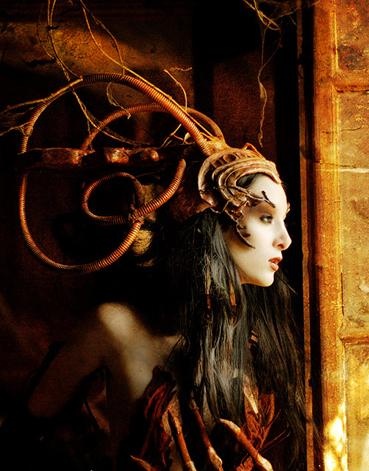
This being is strange and monstrous, but with a beauty about it too - like the beauty of twisted roots that blindly tunnel ever downward, in the damp dark dirt, seeking water far underground.


That explains why some phrases using the word "strange" are so evocative and so full of poetic potential. "Strange and marvelous", "rare and strange", "on stranger tides", "strange but true", "strange flowers of reason", "tis wondrous strange"... all of these phrases just seethe with imagery and a creeping sensation of mystery and the fantastic.


She found me roots of relish sweet,                  
  And honey wild, and manna dew,          
And sure in language strange she said
  “I love thee true.”   - La Belle Dame Sans Merci         


In a way, strange is connected to magic and old beliefs; to other worlds and to times where people were more aware of mystery. The etymology of the word traces a history back to the 13th Century - rooted in French and Latin, it meant "from elsewhere, foreign, unknown, unfamiliar" before it meant "queer and surprising". Perhaps this explains the otherworldly association? What is Faerie but elsewhere to everywhere? What is mystery but "the unknown"; the never-quite-knowable? 


Full fathom five thy father lies;
Of his bones are coral made;
Those are pearls that were his eyes;
Nothing of him that doth fade,
But doth suffer a sea-change
Into something rare and strange.

- The Tempest (illustration by Edmund Dulac)


Sunday, 3 March 2013

The Elusive Quality of Autumn

Autumn leaves in a forest pool...
I am enamoured of Autumn.

It is such an exciting time of year - a season of colour and contradictions; harshness and sensuality, sorrow and celebration. It is a time of fruiting and of dying - a season both "mellow" and tempestuous. It is a time of mystery - a transitioning time from the light and life of summer to the dark, bleak time of winter. As with all "between" times, it eludes definition, save through a poet's metaphors and an artist's brush. 

Mist blurs the boundaries of perception - autumn is a season of mystery...
When we think of autumn we tend to think in terms of images, sensations, emotional stirrings and stories. So I have found it, at least. In writing this blogpost I found my first attempts to describe and define my love for this strange and changeful time of year to be pitifully inadequate in their colourless generalisation;, and found myself recounting instead my vivid memories and perceptions of the season.

Autumn at Ashley's Cottage by Thomas Kinkade


Autumn can be beguiling and sensuous. It is  time when one has a pleasant excuse to stay indoors, wrapped in soft wools while it rains or mist envelopes the house. At this time of year we revel in the crackle, the light and the sharp, exciting smell of an open fire; and we taste the sweetness of stored summer sunlight in the taste of a ripe plum or bulbous, juicy berry and rejoice... Hot, filling, homecooked meals fill us with a contentment and comfort provided by a bounteous harvest.


The traditional harvest feast of Mabon
"Who hath not seen thee oft amid thy store?Sometimes whoever seeks abroad may findThee sitting careless on a granary floor..." - Ode to Autumn, John Keats


Autumn's harvests have traditionally been celebrated with festivals of mythic, religious and communal significance. Though harvest festivals have been of recent years too often commercialised and trivialised in the Western World, I was fortunate enough to experience some of their traditional, mythic flavour when I was in primary school. I attended a Rudolph Steiner school, and in April we celebrated with a communal feast of light and song and story. Each family contributed homebaked food and fresh harvest fruits. The mudbricked ovens (built by children's hands) glowed from within, as hippie parents with long hair and colourful clothes baked pizza on handcarved paddles. In the amphitheatre, surrounded by bushland and decorated with paper lanterns painted with watercolour, the children acted out the mythic archetypes of hero, saint, princess and king. Music was provided by a group of children playing wooden recorders, while others chanted the narration. A drumbeat was heard. From the shadows of the trees came a horned and snakelike figure - a dragon with a dozen little bare feet, pounding joyfully on the dirt. 


Samhain

Dark tales are associated with autumn; a season that is not merely about fruitfulness, but also dying...
Of course, there are darker rituals associated with autumn than the one in which I participated. Darker stories that, however legendary, hold a "truth" in the mind and shape my perception of the season. Autumn evokes for me stories of Samhain - images faces half-bestial and eldritch flickering in and out of shadows at the edge of firelight. The pages of an old book of tales evokes Old British spirits and superstitions, and eerie tales of witches and "ghosties and ghoulies and lang-legged beasties" told around the hearth. There are tales of blood and death and the things beyond the grave that prick the skin on the back of the neck, while outside the wracked trees claw at the stormy sky.

Mist is incredibly evocative...

Keats was right when he said autumn was a "season of mists and mellow fruitfulness", though that description of course does not encompass the whole. Many of my most abiding memories of autumn are of mist rolling into my garden, obscuring the valley and the mountains, beading crystal droplets on the leaves of trees and grass and clover. Some drops roll into the centres of nasturtium leaves, making me think of the pearly dew in the story of Jorinda and Jorindel. Mist also bedews the needle-like leaves of the juniper (blue-green, now taking on a reddish tint) and the golden fringes of the cypress tree. Mist encrusts the wool of my jumper, and my eyelashes and hair. It creates mystery, but gently. It beautifies, even as it conceals. 

Autumn rain
Autumn is also a time of rains - fierce, driven and torrential. Yesterday I looked out of my window at the harbour and marveled at the glory of a rainbow across the water. Five minutes later the entire harbour was blotted from my sight in a sudden flash-downpour that was so forceful, the roofs of the houses below me seemed to "smoke" from the spray sent-up with each droplet. After a minute of white near-blindness, I saw blue sky through the pouring rain. In another two minutes, the rain had completely stopped and the sky was clear again. 

But as well as being a season of darkness and diffuse dimness, Autumn is a season of colour and splendour. The very light is more golden; all colours are more saturated and the sky deepens to a rich sapphire. Most spectacularly the leaves of deciduous trees blaze forth in innumerable shades and hues.

The myriad colours of autumn
How many shades are there of red? Our language can describe crimson, scarlet, vermillion, carmine, blood-red, cerise, claret, puce, roseate, garnet, geranium, russet, rust and titian... And of the other flame hues: yellow and orange, the thesaurus provides us with: champagne, xanthic, creosote, aureate, aurulent, citrine, canary, fallow, flavescent, flavicomous, fulvid, lutescent, primrose, sallow, sulphur, xanthous, tawny, sunshine, ochrous, saffron, cadmium, apricot, bittersweet, carrot, coral, salmon, tangerine, titian and auburn. For  brown we have amber, auburn, bay, beige, bister, brick, bronze, buff, burnt sienna, chestnut, chocolate, cinnamon, cocoa, coffee, copper, drab, dust, ecru, fawn, ginger, hazel, henna, khaki, mahogany, nut, ochre, puce, russet, rust, sepia, sorrel, tan, tawny, terra-cotta, and umber. For green (and there is green in autumn) we have: apple, beryl, bice, chartreuse, fir, forest, malachite, jade, peacock, moss, olive, verdigris, viridian, pine, sage and sap.

Fallen leaves on wet stone - what image can do justice to the indescribable scent and colour of reality?
This is a mighty, and one might say, comprehensive list. But how many of these words are but the names of trees and plants and pigments, found in nature? And what of the myriad tints and gradations that cannot be written? A painter could better capture this iridescence with a brush, but the breadth and vibrancy of Nature's palette in Autumn is unrivaled by any mortal artistry. 

Autumn Leaves, by John Everett Millais
And oh - what are the words for the scents of Autumn? How can one do justice to the smell of wet leaves underfoot; the smell of sunwarmed blackberries or the smell of wood-smoke? And what about the emotions evoked in the soul by the sight of departing birds, flying in wavering arrows towards a warmer land; or the wildness stirred in the soul by the rising winds, until the feet and blood pull you pelting down the road to dance with the blowing leaves; or the state of peaceful melancholy evoked by the contemplation of yellow willows trailing in a slow-moving stream?

The wild winds of autumn stir the soul...

... and set one dancing with the leaves
Autumn seems to me sometimes like a beautiful, emotionally-volatile lover, who dazzles the eye differently in every changing hour; a lover who can be fierce and gentle and cold; generous and destructive; golden and pale and lowering storm all in one day... Infinitely fascinating; infinitely complex; infinitely beautiful. One who never lets you see their whole self - yet in the facets revealed to you is such a beauty that you spend the rest of the year musing on the mystery of their being. One who mocks you for your pitiful attempts at definition.


The Spirit of Autumn
Perhaps the wisest words belong to Robin Hobb, who wrote in her beautiful novel Golden Fool:

"Words do not contain or define any person. A heart can, if it is willing."

I think the same could be said of a season. 

Close bosom-friend of the maturing sun...

Thursday, 7 February 2013

Why everyone should see "The Slipper and the Rose"


What is a song that's never sung?
What is a heart that's never thrilled to being young?
What is a dream that can't come true?
What is my life to me, without my love for you?
- Secret Kingdom, The Slipper and the Rose

Prince Edward: Whatever happens afterwards, I will always remember this moment...

Tonight I watched (for the twentieth time), my favourite of all fairytale movies (and very close to my favourite movie ever), The Slipper and the Rose.

The movie is a musical adaptation of the classic Cinderella story. But there is nothing whatever trite or cliche about this adaptation - nothing caricatured or Disneyfied. I first watched it when I was about five years old, and have watched it several times each year since. Above all movies, it shaped my entire childhood perception of the world, and its magic still affects me just as strongly today.

Since it is sadly unknown in much of the world, I will briefly give a sketch of the storyline:

The moated manor where Cinderella lives, in the tiny kingdom of Euphrania 

After the death of Cinderella's father, his will places her under the protection of her stepmother , with only the memory of love to sustain her. 
The stepmother and stepsisters make "certain drastic economies in the household" ... 

... which involve making Cinderella the maid-of-all-work.

Meanwhile the king and queen urge the prince that "it's your duty to the state not to stay a celibate" while he argues that marriage begins with love, not duty. 
The prince's foolish cousin drops the "teensiest of social briquettes"., with hilarious consequences. 
The Fairy Godmother in her Domythic cottage, writing all the fairytales... 
She "tests" Cinderella before deciding she is worthy of help.


"I thought - a ball. A great ball! The greatest ball that has ever been known, sire! And to it we shall invite every eligible princess in Europe, and even beyond, your majesty."
Cinderella is set the task of making dresses for the ball, but fails miserably. Thankfully, someone steps in to help.
Cinderella" "Me, go to the ball?"
Godmother: "Of course! Wait, that is what you were wishing wasn't it?
Cinderella: "Not wishing... Thinking what it must be like."
Godmother: "Same thing."

Dancing mice. What's not to love?

The prismatically lovely carriage seems to be made of dreams and imaginings...

At the ball, the Prince "conceals his boredom from half a dozen twittering maidens of blue blood" (the princesses between whom he is meant to choose) while the local nobility attend to fill up space
A glittering carriage arrives late to the palace...

... and the "Princess Incognita" arrives. 

Entering the ballroom...

... Cinderella and the Prince are drawn to each-other

The waltz that Cinderella and the Prince dance at this point must be seen to be truly appreciated. It is the most beautiful dance I have ever seen, and earned The Slipper and the Rose two Oscar nominations. It tells the story of a relationship, and makes their falling in love believable.

It really is the most romantic and beautiful dance - ever.

After the dance Cinderella Prince Edward walk in the garden, and the Prince apologises to her for the "ridiculous charade" of the "bride-finding ball". He confesses that he has been "trapped by his birthright", but offers Cinderella his "private kingdom... with no castles and no vassals and no throne".

Unfortunately the chimes of midnight necessitate Cinderella's flight...

... and his pursuit is in vain. 

"Though this lovely night was only a fantasy/ And I know tonight is all there will ever be/ Dancing in his arms forever my heart will never be free... Dreaming of the night he danced with me."
"Could it be that she was only a fantasy? Could it be tonight is all there will ever be?"
Edward: It is unique, like its owner. Who ever fits this slipper, must fit the bill!
King: It really is remarkably dainty... half the size of your mother's... take it away... very disturbing...
Stepmother: "Now push  hard."
Palatine: "Oh I'm pushing, Mama!"

After a fruitless search of "three months, six days, ten hours", Prince Edward and his companion-at-arms John are both tortured by the pangs of love . Edward is educated as to the restrictive nature of "position" and social conditioning.

Frustrated and half-wondering if Cinderella had been a phantom-like "Belle Dame Sans Merci", Edward decides to throw the glass slipper away.

But it is found again by Cinderella.

Joyfully she dances in the fields with the slipper...

... where she is seen.


A passionate reunion...

... but there is talk of war, and the prince must make a marriage of alliance with a powerful kingdom with an "army to fortify the throne" of the tiny and vulnerable Euphrania.

Cinderella makes a noble sacrifice, going into secret exile. 

Edward prays on the eve of his wedding: "Forgive me dearest Cinderella. I have no heart for what I am about to do... I have loved but once. I have loved but you. And I have lost you - twice!"

In her place of exile, Cinderella "can't stop remembering" - until the Godmother shows up "to rise to the occasion and do something spectacular".

The marriage of alliance...
... but someone else has arrived.

Happy, but not yet the ending...

... and that's only a taste of the gorgeousness in store. It can't do justice to the music, the vivacity, the Romance and the magic of this peerless fairytale movie.

Essentially, the first half of the story is the one we are familiar with - except that the characters are far more real and the Prince (Edward) has as great a role in the story as Cinderella. There are a host of wonderful supporting characters (the stepmother, the prince's companion-at-arms, the royal family and the fairy godmother to name a few), which give the film depth  and allow it to explore themes of tradition, class warfare, independence, diplomatic relations and ethical dilemmas. When Cinderella is reunited with the prince at last, their happiness takes second place to the concerns of the kingdom, for a declaration of war requires the prince to make a marriage of alliance to a powerful princess... Of course it ends happily (and satisfactorily) thanks to the cleverness of the Fairy Godmother - but not before both Edward and Cinderella are tested.

The Slipper and the Rose is beautiful in every way - with incredible music, sumptuous costumes, an absolutely wonderful romance, humour and great characters. I can't praise it enough. For anyone who wants to watch it (which should be everyone after reading this!) - you can purchase it on Ebay or *watch here on Youtube*.


In fact, you have no excuse. Enter the fairytale. You will not be sorry. Go and watch it now.