Showing posts with label nature. Show all posts

Wednesday, 2 January 2013

Tolkien and the Elvish Muse

...themselves they named the Quendi, whom we call Elves; but Orome named them in their own tongue Eldar, people of the stars, and that name has since been borne by all that followed him upon the western road.. In the beginning they were stronger and greater than they have since become; but not more fair, for though the beauty of the Quendi in the days of their youth was beyond all other beauty that Iluvatar has caused to be, it has not perished...                                                        - The Silmarillion, J. R. R. Tolkien
Elf Fantastic by John Howe
Whosoever rejoices in the exploration of fantastic and beautiful "secondary worlds" will surely appreciate any "extra" information to add further depth to their immersion. At least, such is the case with me. After recent and delightfully immersive experience watching the entire Lord of the Rings trilogy on one day, and two days later watching The Hobbit (both times dressed in elf-attire) I avidly sought out Tolkien's other volumes on Middle Earth - revisiting the Silmarillion and reading Morgoth's Ring for the first time. 

This picture makes me think of the maiar, or lesser-spirits of Arda - many of whom were helpers of Yavanna, goddess of all living things, and were wondrous in beauty .

Perhaps I had previously been too young to appreciate them properly, but I was struck, as never before, by the wondrous richness of Tolkien's world, and the incredible mythological tapestry he created upon which to weave his tales. For to the lover of myth and great legends like those of King Arthur, the Mahabharata and the Odyssey, the Silmarillion is infinitely fascinating, dealing with the Music of the Ainur and the creation of Arda in the Valaquenta, and in the Quenta Silmarillion the epic exploits of the Elves before the Third Age.  

Morgoth's Ring, cover art John Howe

Morgoth's Ring is composed mainly of notes and various drafts for the Silmarillion: interesting as it reveals the workings of Tolkien's mind and the process of "secondary" creation. But most intriguing of all is the essay "Laws and Customs among the Eldar", which reveals much about the nature and behaviour of the Elves, including marriage customs, naming traditions and the relation of the soul (fea) to the body (hroa). 


Luthien's Lament before Mandos, in the halls of the dead


The immortality of the Elves lies in their fea being "bound" to Arda (the world) until the End of Days, but their bodies can be slain, albeit with difficulty. The souls do not depart the world, but travel to the Hall of Mandos (lord of the Dead) in Valinor - the place to which the Elves depart at the end of The Lord of the Rings. There they are "corrected, instructed, strengthened or comforted, according to their needs or deserts" by the Valar, the gods who reside in Arda, before being reborn in an identical body and enjoying a second childhood sweetened by the intelligence and memory of the first life. After their rebirth however, most Elves do not return to Middle Earth, but stay forevermore in the West, in blessed Valinor.

The Grey Havens, by John Howe

Of the Elves who do not die, and who do not take the white ships into the West - Tolkien writes most poignantly. These are the Lingerers - whose souls, as they remain for long Ages of the world, gradually consume their bodies, until "the body becomes at last a mere memory held by the fea". After the passing of their kindred, these last elves of Middle Earth become invisible to mortal eyes...

However...

"[The Lingerers] do not seek converse with Men at all, save maybe rarely, either for the doing of some good, or because they believe in a Man's spirit some love of things ancient and fair. Then they may reveal to him their forms (through his mind working outwardly, maybe), and he will behold them in their beauty. Of such he may have no fear, though he may feel awe of them... For the hearts of true Men uprise in joy to behold the true likenesses of the First-born, their elder kindred; and this joy no evil can counterfeit."

What is this? For those of us who mourned the passing of the Elves from Middle Earth, or feel sorrow at the loss of magic from the world - Tolkien provides relief. For those of us who feel the beauty of the Elves like shining stars in the heart, and long for them - for us who feel "love of things ancient and fair" - an inspirational fancy. In his creation, the Elves are the muses of art, poetry, music and writing - thus in our mortal makings we reveal their forms... 


I feel the mythic truth of this. I see the high, ethereal beauty of the Elves in art...


In sculpture...


...and in architecture...


I hear their voices in music...

Enya - Aldebaran


Libera - Jubilate Deo


In Nature and in fantasy I feel their presence.


Ancient Voices, by Rob Alexander

In all beauty around me are evidence of the Lingerers. Thus the worlds of Middle Earth and our own world are brought, beautifully, together. 

Saturday, 29 December 2012

Marsh Priestess - a Personal Story


But all I remember 
Are the dreams in the mist... 
There's something out there 
I can't resist


In my last blog post I wrote a bit about the mysterious feeling of sentience one senses sometimes from trees in the forest. It put me in mind of a short story I wrote last year, which was based on my own experiences in the bushland at the bottom of my mountain garden. 

Most of the garden is cultivated, with roses, bulbs and other flowers, deciduous and fruitful trees, little paths and birdbaths... It is a lovely garden, with a magic of its own. But about a hundred metres from the bottom of the garden stand two giant pines, marking the transition from the garden to the wild. Beyond is bushland, often mist-shrouded, where all the colours are different, mysterious and strange and where the eucalypts stand like pale gods with their proud heads crowned by cloud. And at the very bottom is a valley with a grassy, gurgling marsh, full of humming things and secretive trickles. Perhaps the mythic nature of trees is what calls to me, or I sense the borders to otherland fade when I am by a marsh. For sometimes I feel a call to I wander there alone, and at these times I feel a sense of kinship with the forest. 

I hope you enjoy the story.

Photograph credit, Stephen Hayden Photography

Marsh Priestess


I am the priestess of the scorned and wild forest. Afternoons, the softly falling chill brings with it the mists, which, clinging, frost the eucalypts with tiny jewels. I stand on the track my constant pilgrimage has worn, while the borders of reality are shrouded; first the garden, green and tame beyond the furthest pine; the straggling wire fence; the bleached rope swing; all fade. The bush has reclaimed the land from civilisation, and I am enclosed by the pale trees, their stringy bark hanging in rags off white and virgin limbs; initiates disrobing for an ancient ritual. I tread carefully, hesitant to disturb the soft and steady dripping of condensation from the myriad leaves. The track is soft and spongy; new-speckled with tiny ferns I weave around, unwilling to crush.

As I descend, I briefly pay homage to the matriarch, the huge red-bark whose maternal roots shelter and protect the forest’s treasure: the waratah I discovered with my brothers last summer. The red and sticky sap has crusted carnelian, and it beads my forehead as I lean against the trunk. I feel the soil’s moisture soak my knees and watch it slowly darken my skirt. Further down, the grasses have starred themselves in pale blossoms that glow amidst the slate and khaki of the dimming mist. In the half-light my merino cardigan fades to muted steel, until an intruder, stumbling from the end of the road, (hidden a scant thirty metres to my left), would find it hard to see me, my goose-pebbled arms around my wild sister; my wet and darkened hair sticking to my face like sheeted bark.

I near the end of the track, averting my eyes from the plastic teeth of a rake, which leers drunkenly from its precarious position in the fork of a banksia, where my father must have propped it. The rake is a blasphemy to the untamed sanctity of the forest. Angrily, I push it over and watch in satisfaction as it is swallowed by the eager shrubs. A cluster of ferns ends the path, damp fronds caressing a weathered piece of sandstone. Many years ago, the rock was engraved with plain, sensible English, marking the boundary between our property and the next. Now, the crumbled inscription is illegible, translated by the endless dripping of the mists into an arcane script. Here, I too can go no further. The track breaks off at the edge of a sharp depression. Beneath me lies the fertile green of the marsh, waiting silently for nightfall.

The ceremony will not be marked by sunset. My family’s cottage, sitting smugly at the top of the hillside beyond the bushland’s boundaries, regularly catches the last rays of the setting sun. Here, however, obscured in the mist, the marsh is enveloped in mystery. A little to my right, a scribbly-gum has split itself into three, extending over the swamp like the hand of a druid over a cauldron. Gingerly I walk along the middle finger, uncomfortably aware of my sneakers’ tentative friction on the wet wood. Convulsively I grip the twigs then straighten, poised above the morass. As the mist dims and the pale, scented stars light the long grass, I await the invocation, my sacrifice clutched in my hand.

 Sonorously, the bullfrogs give the signal. Symbolically, I sacrifice a piece of my body, heart and soul to the wild spirits of the marsh; a bead from my childhood necklace; a twist of my hair moistened in spit; a name scribbled furtively on a scrap of paper… They slip from my fingers and vanish into the dark trickling of the swamp. On the other side, two foxes perform their mating ritual unconcerned before my gaze. For a few moments, I am one with the forest. But a few moments are all I am granted. The carrying deep voice of my father, floating down the valley, calls me back to humanity. Reluctantly I force myself to turn away from the marsh; to walk slowly back up the path in the chilling fog, feeling the damp cling to my skin; back to reality.

At the border I pause, my hand on the solid trunk of the vast pine marking the end of the forest. Up the hill, past the new-mown lawn and the rose garden, the kitchen light gleams warmly and my father’s shadow moves industriously against the glow. Solemnly, reverently, I turn and make obeisance to the silent eucalypts and they toss their crowns in acknowledgement. Then I cross the border, and make my way up to the house, out of the mist.


Saturday, 15 December 2012

Overheard on a Saltmarsh and the Boundaries to "Otherland"

The Musician, by John Howe

Have you ever heard the voices of the eldritch? Have you ever - passing somewhere secret in the night - believed yourself in the presence of something unmortal? I know of fortunate people who believe they've personally communicated, spied upon or glimpsed something or someone unearthly... I have not, although I wish I would.

Although I long for "proof" or tangible sign of the something otherworldly that I feel (but cannot "know") to be real - I fear that the magical and ethereal hovers between the primal presence of nature and the imagination - perhaps - probably - I will never be able to concretely ground my feelings upon a base of proof.

Eldritch beings - those shapeshifters - can be described in their own realm - that "otherland" - the unreachable, ever desirable place of beauty, mystery and peril. Faerieland, Paradise, Middle Earth and Narnia - all of these imaginary places are but varied descriptions of the same place from whence all mystery and magic originates. While I long desperately to enter these worlds in reality - (though I never quite stop hoping - I still grope the back of wardrobes with my eyes shut, and reach slowly towards mirrors) - the only proven way of visiting these places is through the mind's fantasies - your own or those of others through the medium of books, movies, art and poetry.


There are, however, places on this earth where surely the borders between the worlds are thin - where mystery and magic lingers. In particular, salt marshes are strange and uncanny places. They are boundaries in more ways than one - between the sea, the land and sky. Here, where the tide mingles with the earth, and water rises in a mist toward the sky - surely here is close to "otherland".


The following poem by Harold Monroe manages to capture the fey eerieness of the salt marsh. It is almost as though Monroe - in wandering through that land of "boundaries" - came in fact upon a pair of eldritch beings, and through the medium of poetry - summoned us to his side to "overhear".

Overheard on a Saltmarsh
Nymph, nymph, what are your beads?
Green glass, goblin. Why do you stare at them?
Give them me.
No.
Give them me. Give them me.
No.
Then I will howl all night in the reeds,
Lie in the mud and howl for them.
Goblin, why do you love them so?
They are better than stars or water,
Better than voices of winds that sing,
Better than any man’s fair daughter,
Your green glass beads on a silver ring.
Hush, I stole them out of the moon.
Give me your beads, I want them.
No.
I will howl in the deep lagoon
For your green glass beads, I love them so.
Give them me. Give them.
No.


This poem just sings with mystery. I have loved it ever since I was a child - and it first brought to my mind a dark marsh, tiled with glimmering pools and deep lagoons, rising mist and a high, cold moon. The very strangeness of the conversation between the nymph and goblin convinces the reader of their otherworldiness. The desperation in the goblin's words - his grasping, howling desperation for the green glass beads - resonates with my own longing for a world "better than the stars or water/Better than the voices of winds that sing". The quiet negative in the nymph's words is inevitable as nature.

The Dead Marshes by Alan Lee

Friday, 14 December 2012

Ida Rentoul-Outhwaite and the Glory of Solitude


I love solitude. There is a supremely powerful and elemental feeling that attends me only when I am alone in nature. Nowhere else, and at no other time do I feel my thoughts attune themselves so much with the infinite - do I become so convinced of the vital connections between myself and everything earthly and unearthly - do I hear and feel the rhythm of the wild.

Often I feel the urge to forsake society for a shadowed space of trees - therein to wander, slipping in between the boles; softly to tread the mulch of fallen leaves and touch the silk and shiny new-growth budding at the tips of twigs... I am ever drawn to the places of beautiful desolation, beyond the signs of human influence - such as a deserted shoreline lit by lonely stars, or an airy pinnacle overlooking a valley-basin  filled with trees and ebbing clouds.


This is not to say that I am antisocial - that I misanthropically detest the company of others and find no enjoyment in human society. On the contrary - I love the company of friends, and rejoice in the discovery of kindred-souls, delighting in our mutual sympathy and inspiration. Despite all that however, I have a wildness in my soul that feels most fulfilled when alone among the things of nature. There I can dance within the wind and walk beside the creatures of the wild. There I feel myself a part of something vast, eternal and powerful, and paradoxically (when I am so awed by the majesty of nature) I am at the same time so aware of the grandness of my identity.


I cannot adequately describe the word-transcending freedom and glory of this kind of solitude - the kind of exultant isolation that the Romantic poets understood. To "wander lonely as a cloud" comes close - but does not express the whole...

Perhaps the art of Ida Rentoul-Outhwaite, Australian artist of the early twentieth century, can help me to convey the glory in the solitude my pen can only falteringly express. As you will see from her paintings and ink-drawings - she was a sister-wildheart of mine.


"The Little Witch" is probably Outhwaite's most famous painting - an illustration for the book Elves and Fairies, published in 1916. I love this picture for Outhwaite's ability to convey the tempestuousness of the young witch's spirit through her stormy hair, while the tree is deliciously Rackham-esque. This witch wears a dainty muslin gown - proper for a young lady of the town (outlined below the hill) - yet no demure maiden is the girl standing ready to take off into the unlimited freedom of the air, wearing her dramatic green cloak and peacock-feather hat and surrounded by her familiars the frogs and the cat - while the bats call to her to join them in jagged flight.


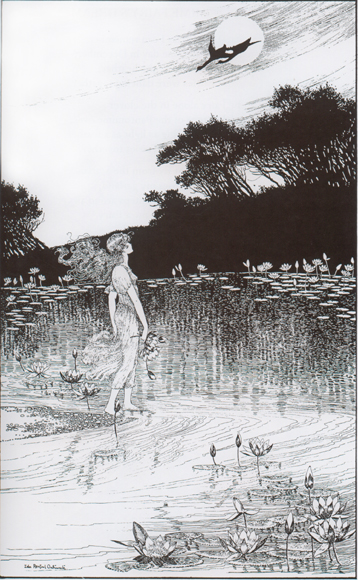
While this image for The Enchanted Forest has some similarities to the previous painting (with both using bats as a motif) this bat-rider is even more at home in nature than the witch. I love this painting for its evocative depiction of the beauties of an Australian marsh, with glass-like water; the transient yet constant presence of the reeds, and their silhouette against the sky. I can almost smell the water, hear the high squeaks of the bats on the edge of hearing, and feel the cooling breeze of twilight ripple the water and lift the rider's gauzy wings.


"Echo" is still more ethereal, with an overwhelming impression of wind and loneliness and longing. I am awestruck by Outhwaite's ability to depict a reflective surface - the surface of a shallow lake - using only black ink and white paper.


"The Last Fairy" has a mournful title - but the image itself does not strike me with a sorrowful feeling, rather one of wonder - the kind of wonder I feel when I am sometimes struck by something marvelous and strange in nature. This fairy stands beside a glowing pool - but lit from what radiance? Surely not the moon? I am also excited by the ultimate blackness of the forest behind her.


"Fairy of the Snow" is a picture full of elemental power. This comes closest to expressing my sense of the grandeur of the isolated self - a snow-spirit standing on a lonely rock, delicate beside the massive mountains behind her, but stronger than they, for she can cover their stern blackness in flurrying, terrible and glorious whiteness...


"Moonrise" - probably my second-favourite of all Outhwaite's artworks. It expresses my feelings sometimes when I, like the girl in the picture - leave the warmth of my house for the brighter moonrise.


My absolute favourite of Ida Rentoul-Outhwaite's pictures - "Ti-Tree". I don't know exactly why this one speaks so strongly to me - perhaps because I love to climb trees so much, and find such beauty in a windswept tree. Perhaps it is because I know there is an exhilaration to facing the the elements - riding and swaying on a whipping tree, feeling danger and delight in equal measure. Perhaps it is because the girl seems part of that illusion by which the moon appears to race in the sky through speeding clouds. Who can tell? Nevertheless, such is the wonder of solitude, and the power of nature.