Wednesday, 19 December 2012

Why are we so Fascinated by Pirates?

 
It is, it is, a glorious thing to be a pirate king.
Who hasn't dreamed of "a pirate's life" at some point in their lives? When we think of "pirates" our imagination flies to the Spanish Main, or to the Caribbean - even to Neverland. Our mental images of pirates have been shaped by popular culture for centuries - a myth-making and glorification of bandits, similar to the legend of Robin Hood. Since the writer "Captain Charles Johnson" published his influential work A General History of the Pyrates in 1724 - the figure of the pirate has assumed legendary qualities, and accrued some interesting (but fictitious) characteristics. We invest these beings with attributes we desire or feel we lack - courage, rebelliousness, a devil-may-care outlook on life, loyalty to others (in the form of "crewmates"), adventurousness, confidence... They become the agents of mystery - hailing from exotic locations, bound for strange shores. They do not conform to society - observe their bohemian dress and colourful language. Oh if only we dared to follow their example. 

We all know that the reality of piracy was not so attractive as popular culture has portrayed it. While the so-called "golden age" of piracy has been depicted as a time of lavish treasure and boundless opportunity for adventurous souls to discover new places and make their fortune - conditions aboard even the cleanest and best-equipped ship became quickly unsavoury when the sweaty and unwashed crew had sailed a week or two... While the captain's cabin was palatial compared to the rest of the ship (almost big enough to stand up in), most crewmembers had to bunk in cramped and squalid conditions, or swing in flea-swarming hammocks. Those picturesque Spanish galleons - they had the euphemistically named jardins instead of toilets. The food was at best bland and at worst rancid, bilge-soaked or rendered inedible by rats, mildew or weevils. The unsanitary conditions and poor nutrition made the ships into breeding grounds for disease. Did you ever wonder where the phrase "scurvy rascal" came from?

This is the face of your average pirate.
But surely we can afford to put up with a bit of hardship to live such a free and wonderful life as pirates led? Now they weren't stuck behind a desk all day. Nor are they required to conform to society's standards of beauty. And with the job comes so many cool tricks! We all know what pirates do - they swing around on rigging, quaff quarts of rum, romance (seduce is such an ugly word) beautiful and fiesty yet ultimately yielding women, engage in frequent and flamboyant sword-fights and walk around with parrots on their shoulders.


And we mustn't forget the golden lure. Just think of the treasure! Who doesn't love golden chalices and chests of silver coins? Speaking of chests - check out that beauteous buxom pirate wench! She even has a sword! How empowering is that? And anyway - everyone knows that pirates were gentlemen underneath... Well - maybe not gentlemen, after all they had hard lives and were rebels against society! But deep down underneath they were decent. Just look at Jack (I mean Captain Jack) Sparrow!

Just a lovable rogue... right?

The truth is, our perception of piracy is a romantic fantasy. "Piracy" really refers to acts of violent crime committed at sea (but can also be stretched to include violent robbery on land and air). And our image of the swashbuckling pirate is based only on a small period in history (the aforementioned "Golden Age" of piracy) whereas piracy has actually existed since the 14th Century BC and still exists today.

Nor were pirates the attractive idealists, attractive daredevils or unattractive-yet-comical characters we have seen on stage or screen. Rather they were hardened criminals who, although they did not commonly "kill all hands on deck" (simply because it would cost them too many lives), felt no compunction in committing murder, rape, extortion and theft.

Wait - you mean I'm not drawn from life?
Nor is piracy a Western phenomenon. Rather it is a global crime - with pirates found all over the world throughout history, including China, India and North Africa. In modern times pirates are still to be found in the waters of Somalia, Guinea and the Danube River.

Viewed out of the rose-coloured lenses of popular culture, a pirate presents a truly ugly sight. But is there nothing good we can take from the pirate trope? Is it necessarily a dangerous fantasy? Of course not!

The pirate legend satisfies the universal human need for heroes - mythical figures onto whom we project the "admirable" qualities we feel we lack in ourselves and our society. Today we feel restricted by bureaucracy, obliged to conform to social expectations and niceties. We look to the pirate ship as a means to sail away from the strictures of modern life. The pirate's crew, appeals to us with its tight-knit sense of belonging - a connection we feel we lack in a technologised society. In a world where  security is of paramount concern - the image of the adventurous, risk-taking treasure-seeker offers hope and consolation. The pirate reality was and is brutal and dark. But then, so was, in all likelihood the "reality" behind so many of our mythological figures - the ancient Greek heroes, King Arthur and Robin Hood...

It is the nature of the mythic to transcend its origins. We as humans need these inspirational, larger than life figures. Therefore the pirate fantasy figure has a great deal of value, so long as we remain aware of the disturbing truth; and do not let the attractive myth tempt us to glorify the ugly reality.


Monday, 17 December 2012

Interesting and Liberating - Thoughts on Looking Up


I love to look up. There is so much to see and rejoice in - the ever-changing light spectacle of the sky; the unique and often quirky facades and tops of buildings; the faces of people passing, and of course, trees. I am never bored when I look up. In the most dingy part of the city my eye seeks out, and finds beauty - the wispy mare's tails in the sky, curiously bubbled glass on windows, and the stained-glass effect of sunlight seen through leaves on a plane tree. In surroundings with less aesthetic disadvantages - such as a suburb verdant with trees and gay with flower gardens, or better still, the country - there is even more to see when I turn my eyes upward.

The trees are still more beautiful - have you ever noticed when certain trees are blown by the wind, the sun creates reflections on the outer surface, like a bunch of silver shards shaken on thin wires? Or seen a winter-blasted tree clawing at the sky, like something out of an Arthur Rackham illustration? And faces! Such interesting speculations can be had, on the cause of an expression, or the history of a line. Is that woman's face creased with wisdom or bad temper? Is that man's vacant expression indicative of an empty mind - or is he wandering in some personal dream world?

With such constant stimulation for the eye and brain to be found when looking up - why is it that I see so many people with constantly downturned eyes?

Whenever I am anywhere - out walking in my neighbourhood, in the park, in a shopping mall or in the city - I see them. When I walk by, they scuttle or meander past, eyes down in avoidance of human contact. Bored, they hunch over their iPhones, or slouch idly looking at scraps of rubbish blowing like tumbleweeds across the road.  It would seem most people spend their lives looking downward - at the ground or at their electronic gadgets.

It bothers me. And there are several reasons why.

Firstly, the view when looking downward is so uninspiring. What are all these people looking for on the ground? Surely not gemstones. Now if the streets really were "paved with gold" or studded with gems (as  innocent medieval rustics believed of London and later conquistadors believed of El Dorado) - if our city streets were littered with jewels rather than junk, then I too would assiduously rake the ground with my eyes. But aside from the aforementioned (and depressingly familiar) bit of rubbish - the urban street contains few treasures. Looking down, you are likely to see nothing more interesting or spirit-lifting than grey pavers, concrete and asphalt, blobbed with the tar-like and shiny spots of old chewing gum, scattered with cigarette butts and grimy leaves. And instead of faces - a parade of legs and feet adorned with so much black leather; so many Nikes and stilettos. Where are the vistas - the colours and the wide space, where the imagination is free to roam? Suffice it to say, turning the eyes perpetually downward, rather than up toward the horizon or beyond yields only a limited view, which in turn provides limiting stimulation for the mind and imagination.

My second reason for raising my sights is that it allows me to take my bearings on my surroundings and my life. Without our destination in  our sights - how can we properly direct ourselves? To me, this constant looking down implies a lack of purpose - a directionless wandering of the feet and of the mind. If we look up, then we can clearly see where we want to go, and in a real and metaphorical sense, take steps accordingly.

Finally - it is an act of submission and self-effacement to walk around with perpetually downcast eyes. Every time we drop our eyes before someone else, we self-abnegate, signalling a lack of assertiveness. Whether we do it out of fear, awkwardness or a desire to not stand out - it badly affects our psyches, making us more likely to give way before the opinions of others and stand small.

To break the negative cycle, try raising your eyes. Meet the eyes of others, not in a spirit of confrontation, but creating a moment of human connection and making, every time, a quiet declaration of courage and self-worth. Meeting someone's eye, even briefly, says "I am your equal, and I'm not afraid to show it". When it is time to break contact - look aside, not down. See the trees and the buildings, and the faces of all those other wonderful, complex human beings. Feel yourself their equal too. Eye contact is an empowering experience - looking up is both interesting and liberating.


Real Life Places Straight Out of Fantasy

Come travel with me to the truly fantastical places of the earth.

Often it can seem that this world of ours is depressingly and incorrigibly mundane - that all wonder and magic retreated, against the steam-powered onslaught of the Industrial Revolution and later against the threat of nuclear and biological catastrophe - into pages, pixels, daubs and reels of film: into the recesses of human consciousness, never to emerge. As worldwide travel becomes more commonplace - we think we know all there is on Earth - and to dreamers like myself it can be saddening to think that the fantastical realms we long for are unreachable save by proxy... I sigh and imagine a cold, Romanceless world -

- and then I am proven wrong - delightfully wrong.

Again. 

And again.

And again.

The following images were discovered on Quora and I highly recommend you spend time looking through ALL the pictures on the site in this category as they will truly feed your organ of Wonder and transport you to far distant lands (admittedly still by proxy, but if you are able to travel you may have the capability to visit these places in reality). 

Climb astride your steed of choice - horse, camel, dragon or pegasus - or if you prefer a vehicle - air balloon, motorbike or unicycle and join me in the journey.


Our first place of note is Bagan Myanmar. These ancient pagodas and temples number in their thousands and are the magnificent remnants of "The Kingdom of Pagan" in Burma. Although these temples no longer sound with the prayers of the devoted - the wonder and mystery of the site persists.


Next on our travel agenda are the Italian Dolomites. This scene seems like an Arcadian paradise - straight from "The Pastoral Symphony" in Fantasia - we expect to see the gods of Ancient Rome - Jupiter and his family - to emerge from the clouds, triumphantly proceeding to glorious accolade, into the valley. The scenery is truly god-worthy. 


Let us turn now and follow the track of the stars, drifting in calm waters wherever the currents and breezes lead... Wait - trail your hand in this body of water and a line of light will trail from each of your fingers. How is such a thing possible? This phenomenon is caused by bioluminescence - the waters of Mosquito Bay in Vieques, Puerto Rico teem with millions of microscopic organisms that shine brilliantly when disturbed. 


In the jungle of Cambodia there exists the ultimate place of glorious decay - where the grand edifices of a vanished civilisation stand crumbling in the grip and tangle of strangler figs. Marvel at the force of nature, and the beauty that is Ankor Wat.


Are those towers on the horizon? If they are - no mortal hand has shaped them. This is a fantasy city carved by wind and rain - the pillars of Cappadocia, Turkey - turret-like caps of hard stone on soft, easily eroded pedestals. Some of the rock formations here have been further carved and catacombed by humans to form habitations - but the locals name them "fairy chimneys".


Welcome to Narnia-on-Earth. This is a truly magical place of infinite wonder - containing crystal-pure and aquamarine pools fringed with icicles and white-feathery pines in winter; verdant forests and cascades of paradisaical hues in summer. Here is ample magic for the searching, at Plitvice National Park, Croatia.     


Do you wish to travel out of this world completely? The Socotra Island in Yemen is the closest you will get to alien life while still earthbound, containing bizarre and fantastical lifeforms that evolved for aeons in isolation... 


Our next destination could be the "lagoon" from Neverland - the one that forms in brilliant colours behind your eyelids when you squeeze your eyes tight as possible... but this place is the "Liquid Rainbow" or Cano Cristales in Columbia.


"The Wave" in Arizona is one of the most eye-watering and surreal natural formations- a place of vivid colours that change with every caprice of the weather and position of the sun. This desert has its cousin in the perilously beautiful "Desert of Colours" from the Neverending Story - imagine running over these striped undulations on the back of a flaming lion...


Halt here for a moment at the rim of the pit of the Inferno and gaze into Hell's depths. Dante himself would quail. Or do we look into Sauruman's foundry - where the Uruk-Hai are born from fiery mud and tortured elves? We are at Darvaza, Turkmenistan - and only a fool would dare to get any closer...


From the pit of Hell, to Eden's ease - let us rest a while by the pristine, natural pool at the Sua Trench, Samoa.


High as the surrounding hills, the Tiantan Buddha meditates in the verdant valley of  Lantau Island, Hong Kong, dispensing benevolence and wisdom with every breeze that rushes between the mountains and rustles the treetops.


"But rose-red as if the blush of dawn,
that first beheld them were not yet withdrawn;
The hues of youth upon a brow of woe,
which Man deemed old two thousand years ago,
match me such marvel save in Eastern clime,
a rose-red city half as old as time." -  John Burgon


We pass through a warm-hued fissure in a desert cliff and come upon the magnificent facade of a city, carved into the very cliffs. This is a precious, palatial mausoleum - the memorial of the ancient civilisation of the Edomites. The "rose-red" city of Petra in Jordan well merits a place on our journey.


This delicate seeming sanctuary in the Columbian canyon of the Guáitara River owes its creation to the miraculous healing of a deaf-mute girl. Although it was built fairly recently (in 1949) - its appearance is straight from fairytale and its miraculous origins add wonder to the already beautiful Santuario de las Lajas.


This monument seems straight out of "Ozymandias" - we expect to see "nearby, on the ground/Half sunk, a shattered visage"...  But this is no monument to an ancient king's hubris. El Mano del Desierto in Chile was created in 1992 by sculptor Mario Irarrázabal to express human vulnerability in the presence of nature. Its very size is poignant - expressive of the same futility so well conveyed in Shelley's poem.


Now we come to a city in the clouds - the Incan "estate" of Macchu Pichu in Peru. Although it has fallen from its state of sacred city - its stones still hold commune with the winds and stars, and proudly the weathered ruins overlook the valley Urubamba.


If you, like me, thrilled to the glowing wonderland of Pandora in Avatar - try visiting the Waitomo Caves, New Zealand, the haunt of millions of glow worms that star the stalactites of the caves...


This looks like a fantasy fountain - painted in beautiful hues by the ores and pigments of the earth and sun - Fly Geyser, Nevada is worthy of any otherworldly domain. It looks as though it ought to have mythologies written to its huddled forms - a petrified first-family spraying hot life over the world.


I dare you to find a more imposing and terrible tower in a fantasy book to rival the Hassan Tower, Morrocco. This tower was intended to be the base of the tallest minaret in the world - to the peak of which a horseman should have been able to ride on long ramps - but construction stopped halfway (like the tower of Babel) when the Sultan Yacoub al-Masour died in 1199BC.


This pearly bridge and impossibly aqua river in Bosnia-Herzegovia is the perfect place for us to conclude our traveller's log, for now. Here we can find sweet and tranquil rest in a fairytale town of Mostrar. But the journey never ends - and soon we will shoulder our packs and ride together, following the river to parts unknown... 

Who can tell what wonders we will find? The world is wide and strange, still.


Saturday, 15 December 2012

Overheard on a Saltmarsh and the Boundaries to "Otherland"

The Musician, by John Howe

Have you ever heard the voices of the eldritch? Have you ever - passing somewhere secret in the night - believed yourself in the presence of something unmortal? I know of fortunate people who believe they've personally communicated, spied upon or glimpsed something or someone unearthly... I have not, although I wish I would.

Although I long for "proof" or tangible sign of the something otherworldly that I feel (but cannot "know") to be real - I fear that the magical and ethereal hovers between the primal presence of nature and the imagination - perhaps - probably - I will never be able to concretely ground my feelings upon a base of proof.

Eldritch beings - those shapeshifters - can be described in their own realm - that "otherland" - the unreachable, ever desirable place of beauty, mystery and peril. Faerieland, Paradise, Middle Earth and Narnia - all of these imaginary places are but varied descriptions of the same place from whence all mystery and magic originates. While I long desperately to enter these worlds in reality - (though I never quite stop hoping - I still grope the back of wardrobes with my eyes shut, and reach slowly towards mirrors) - the only proven way of visiting these places is through the mind's fantasies - your own or those of others through the medium of books, movies, art and poetry.


There are, however, places on this earth where surely the borders between the worlds are thin - where mystery and magic lingers. In particular, salt marshes are strange and uncanny places. They are boundaries in more ways than one - between the sea, the land and sky. Here, where the tide mingles with the earth, and water rises in a mist toward the sky - surely here is close to "otherland".


The following poem by Harold Monroe manages to capture the fey eerieness of the salt marsh. It is almost as though Monroe - in wandering through that land of "boundaries" - came in fact upon a pair of eldritch beings, and through the medium of poetry - summoned us to his side to "overhear".

Overheard on a Saltmarsh
Nymph, nymph, what are your beads?
Green glass, goblin. Why do you stare at them?
Give them me.
No.
Give them me. Give them me.
No.
Then I will howl all night in the reeds,
Lie in the mud and howl for them.
Goblin, why do you love them so?
They are better than stars or water,
Better than voices of winds that sing,
Better than any man’s fair daughter,
Your green glass beads on a silver ring.
Hush, I stole them out of the moon.
Give me your beads, I want them.
No.
I will howl in the deep lagoon
For your green glass beads, I love them so.
Give them me. Give them.
No.


This poem just sings with mystery. I have loved it ever since I was a child - and it first brought to my mind a dark marsh, tiled with glimmering pools and deep lagoons, rising mist and a high, cold moon. The very strangeness of the conversation between the nymph and goblin convinces the reader of their otherworldiness. The desperation in the goblin's words - his grasping, howling desperation for the green glass beads - resonates with my own longing for a world "better than the stars or water/Better than the voices of winds that sing". The quiet negative in the nymph's words is inevitable as nature.

The Dead Marshes by Alan Lee

Friday, 14 December 2012

Ida Rentoul-Outhwaite and the Glory of Solitude


I love solitude. There is a supremely powerful and elemental feeling that attends me only when I am alone in nature. Nowhere else, and at no other time do I feel my thoughts attune themselves so much with the infinite - do I become so convinced of the vital connections between myself and everything earthly and unearthly - do I hear and feel the rhythm of the wild.

Often I feel the urge to forsake society for a shadowed space of trees - therein to wander, slipping in between the boles; softly to tread the mulch of fallen leaves and touch the silk and shiny new-growth budding at the tips of twigs... I am ever drawn to the places of beautiful desolation, beyond the signs of human influence - such as a deserted shoreline lit by lonely stars, or an airy pinnacle overlooking a valley-basin  filled with trees and ebbing clouds.


This is not to say that I am antisocial - that I misanthropically detest the company of others and find no enjoyment in human society. On the contrary - I love the company of friends, and rejoice in the discovery of kindred-souls, delighting in our mutual sympathy and inspiration. Despite all that however, I have a wildness in my soul that feels most fulfilled when alone among the things of nature. There I can dance within the wind and walk beside the creatures of the wild. There I feel myself a part of something vast, eternal and powerful, and paradoxically (when I am so awed by the majesty of nature) I am at the same time so aware of the grandness of my identity.


I cannot adequately describe the word-transcending freedom and glory of this kind of solitude - the kind of exultant isolation that the Romantic poets understood. To "wander lonely as a cloud" comes close - but does not express the whole...

Perhaps the art of Ida Rentoul-Outhwaite, Australian artist of the early twentieth century, can help me to convey the glory in the solitude my pen can only falteringly express. As you will see from her paintings and ink-drawings - she was a sister-wildheart of mine.


"The Little Witch" is probably Outhwaite's most famous painting - an illustration for the book Elves and Fairies, published in 1916. I love this picture for Outhwaite's ability to convey the tempestuousness of the young witch's spirit through her stormy hair, while the tree is deliciously Rackham-esque. This witch wears a dainty muslin gown - proper for a young lady of the town (outlined below the hill) - yet no demure maiden is the girl standing ready to take off into the unlimited freedom of the air, wearing her dramatic green cloak and peacock-feather hat and surrounded by her familiars the frogs and the cat - while the bats call to her to join them in jagged flight.


While this image for The Enchanted Forest has some similarities to the previous painting (with both using bats as a motif) this bat-rider is even more at home in nature than the witch. I love this painting for its evocative depiction of the beauties of an Australian marsh, with glass-like water; the transient yet constant presence of the reeds, and their silhouette against the sky. I can almost smell the water, hear the high squeaks of the bats on the edge of hearing, and feel the cooling breeze of twilight ripple the water and lift the rider's gauzy wings.


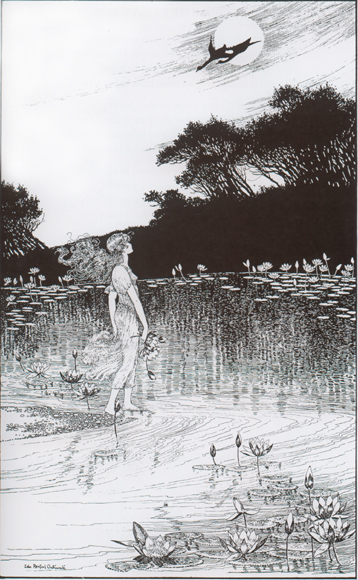
"Echo" is still more ethereal, with an overwhelming impression of wind and loneliness and longing. I am awestruck by Outhwaite's ability to depict a reflective surface - the surface of a shallow lake - using only black ink and white paper.


"The Last Fairy" has a mournful title - but the image itself does not strike me with a sorrowful feeling, rather one of wonder - the kind of wonder I feel when I am sometimes struck by something marvelous and strange in nature. This fairy stands beside a glowing pool - but lit from what radiance? Surely not the moon? I am also excited by the ultimate blackness of the forest behind her.


"Fairy of the Snow" is a picture full of elemental power. This comes closest to expressing my sense of the grandeur of the isolated self - a snow-spirit standing on a lonely rock, delicate beside the massive mountains behind her, but stronger than they, for she can cover their stern blackness in flurrying, terrible and glorious whiteness...


"Moonrise" - probably my second-favourite of all Outhwaite's artworks. It expresses my feelings sometimes when I, like the girl in the picture - leave the warmth of my house for the brighter moonrise.


My absolute favourite of Ida Rentoul-Outhwaite's pictures - "Ti-Tree". I don't know exactly why this one speaks so strongly to me - perhaps because I love to climb trees so much, and find such beauty in a windswept tree. Perhaps it is because I know there is an exhilaration to facing the the elements - riding and swaying on a whipping tree, feeling danger and delight in equal measure. Perhaps it is because the girl seems part of that illusion by which the moon appears to race in the sky through speeding clouds. Who can tell? Nevertheless, such is the wonder of solitude, and the power of nature.

Wandering Aengus and the Search for Creative Inspiration

The following evocative and magical poem by William Butler Yeats was brought to my attention (most appropriately) by the magical writer Cecilia Dart-Thornton, herself a creator of worlds most wondrous and strange.

The Song of Wandering Aengus
I went out to the hazel wood,   
Because a fire was in my head,   
And cut and peeled a hazel wand,   
And hooked a berry to a thread;   
And when white moths were on the wing,
And moth-like stars were flickering out,   
I dropped the berry in a stream   
And caught a little silver trout.   
   
When I had laid it on the floor   
I went to blow the fire a-flame,
But something rustled on the floor,   
And someone called me by my name:   
It had become a glimmering girl   
With apple blossom in her hair   
Who called me by my name and ran
And faded through the brightening air.   
   
Though I am old with wandering   
Through hollow lands and hilly lands,   
I will find out where she has gone,   
And kiss her lips and take her hands; And walk among long dappled grass, And pluck till time and times are done, The silver apples of the moon, The golden apples of the sun.

by W. B. Yeats.
I love the poem, for to me it perfectly conjures up a vision of creative searching and striving, dealing with an artist's chasing after an elusive muse, the search for wisdom and the fire of inspiration. Since Yeats was a supreme word-painter, the poem also summons up in my synaesthesic mind a glorious vision of rich jewel-like colours, through which wanders a magic wind, singing in tones both sonorous and eerie.

In “The Song of Wandering Aengus” Yeats uses Irish mythology and Celtic symbolism to compose an allegorical exploration of creativity. Aengus, in Irish legend is god of love and “poetic inspiration”.


I went out to the hazel wood/Because a fire was in my head

To the Celts, hazel trees had magical properties, containing wisdom and inspiration. The “fire” in Aengus’ head refers to the Irish concept of imbas or “state of creative inspiration”. As I read the poem, in my mind’s eye I see Aengus striding into the green secrecy of the hazel wood – driven by the passion and frustration of his fiery spirit, seeing cool ease among the leaves of wisdom.


And cut and peeled a hazel wand/And hooked a berry to a thread 
With these lines I see Aengus take a branch from the tree of wisdom, trim and peel it to create a fishing rod that shines whitely in the forest with the pale inner hazel-core. In casting his eyes around for suitable bait, Aengus’ eyes light upon a berry on a bramble (symbolic of blood to the Celts) which he uses to bait his hook.

And when white moths were on the wing/And moth-like stars were flickering out/I dropped the berry in the stream/And caught a little silver trout

In casting his hazel rod and dropping berry-bait into the stream to catch a trout (a fish connected with the Druidic Salmon of Wisdom) – Aengus symbolically offers blood-sacrifice in exchange for wisdom. This section of the poem also contains some extraordinarily beautiful imagery – in the fading of the night; the pre-dawn grey of earliest morning, I see white moths flitting from the forest, their wings flickering the pale stars. I see shadowy silhouette of Aengus casting his pale hazel wand with its ghostly thread and dark waters closing over the blood-berry. Then – the wriggling and flashing of the “silver trout” as it is dragged out of the enclosing stream, its sporadic flicks of tail – the struggles of an idea – as Aengus carries it home.


When I had laid it on the floor/I bent to blow the fire a-flame/But something rustled on the floor/And someone called me by my name./It had become a glimmering girl/With apple-blossoms in her hair 
Quick with life and movement in the stream, when “laid on the floor” before Aengus’ home-fire the trout cannot lie still, but “rustles” its silver scales on the ground behind the fisherman. While he goes to “blow the fire a-flame” (the imbas in his head reigniting on the hearth) the trout transforms into the creative muse – a “glimmering girl” crowned with a wreath of apple blossoms (Celtic symbols of art and poetry).


Who called me by my name and ran/And faded through the brightening air 
In calling his name, according to folkloric traditions, the “glimmering girl” binds Aengus to do her will – and he is bound to follow when she flees into the growing sunlight.

Though I am old with wandering/Through hollow lands and hilly lands/I will find out where she has gone 
Aengus’ quest to rejoin his muse thus consumes and directs his life – the terrain symbolic of the often bleak and difficult struggles that an artist encounters on their eternal creative journey.


And kiss her lips, and take her hands;/And walk among long dappled grass/And pluck till time and times are done,/The silver apples of the moon/The golden apples of the sun

In the last lines of the poem, Aengus sketches the felicity he imagines when he finds the “glimmering girl” – the joys of making his journey alongside wisdom and inspiration. Finally he reveals the ultimate purpose of his creative journey – union with his muse. The gold and silver apples again draw on Celtic symbolism – this time fortelling a fertile fruiting of art and poetry given further significance by the male/female associations of moon and sun. Thus the precious fruits Aengus hopes to pluck with the “glimmering girl” represent the creative issue of the poet and the muse; immortal as the golden apples of Idun or the Hesperides.


Of course – while it is fascinating to try and discern the deep allegorical weft in this tapestry of a poem – its true magic lies in its own immortal vision of wonder. As a modern mythologist and word-painter, Yeats is unparalleled.